Will AI data centers soak up the last of the valley’s water?
Questions about artificial intelligence and jobs, ethics, even the end of humanity may be swirling through the ethernet right now but folks in the San Joaquin Valley want to know: What about the water?
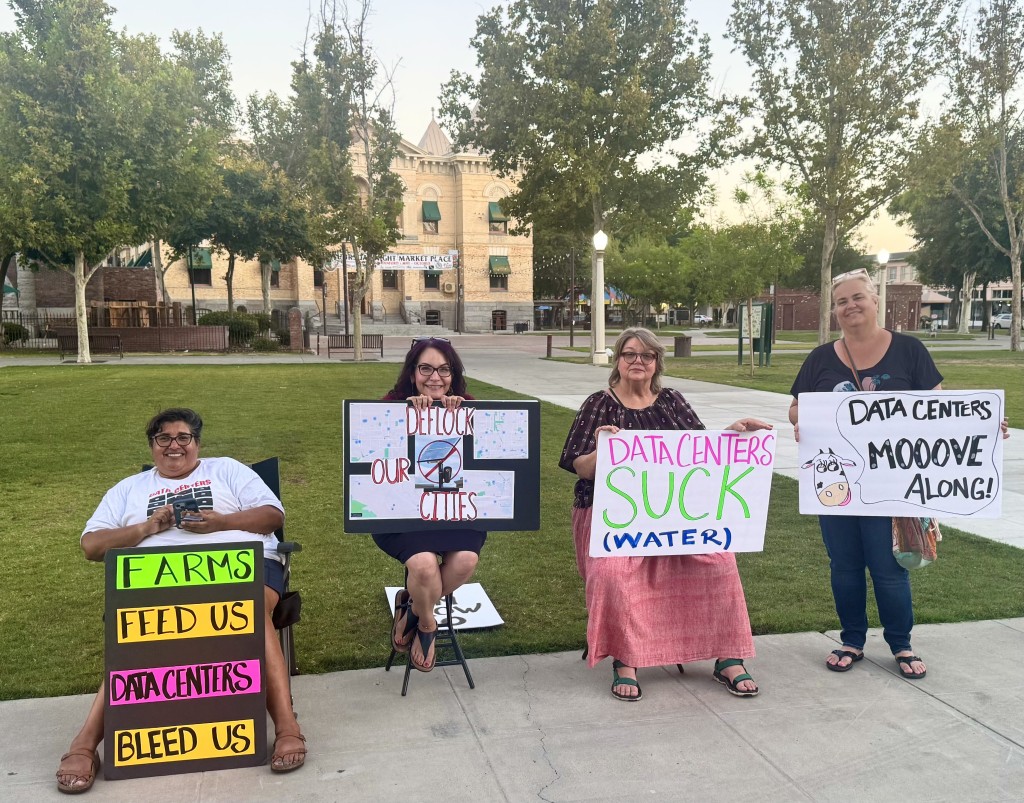
Proposals for two “mini” AI data centers on the fairgrounds in Tulare and Kings counties recently generated a firestorm of questions and angry comments. They are far from approval, but residents fear the notorious power and water guzzling centers will drain already stressed water supplies.
Whether they would depends on a lot of factors, including the size and type of data center.
One thing is certain, whatever water they use, it must be accounted for, according to water managers.
“We’re gonna need to know what they’re pumping, whether it’s in a formal way or we force our way in to find out,” said Aaron Fukuda, manager of the Mid-Kaweah Groundwater Sustainability Agency (GSA).
He referred to the often veiled information about data center water usage.
Water use estimates vary widely and depend on a center’s size and type of cooling technology. Typically, a 1 megawatt center will use 18.6 acre feet of water per year, according to a 2021 study published in Nature.
A bill to require disclosure of exact water usage by AI data centers was vetoed by Gov. Gavin Newsom last year.
Two new bills, AB 2469 and AB 2619, are, again, aiming for water use disclosure.
If farmers have to meter and pay by the acre foot for their groundwater, so must data centers, Fukuda said.
“We have to account for it,” he said.
“We’re gonna need to know what they’re pumping, whether it’s in a formal way or we force our way in to find out.”
– Aaron Fukuda, manager of the Mid-Kaweah Groundwater Sustainability Agency (GSA).
Especially in Tulare and Kings counties – already under state scrutiny for excessive pumping – and where the nationwide debate over American’s thirst for artificial intelligence landed in July.
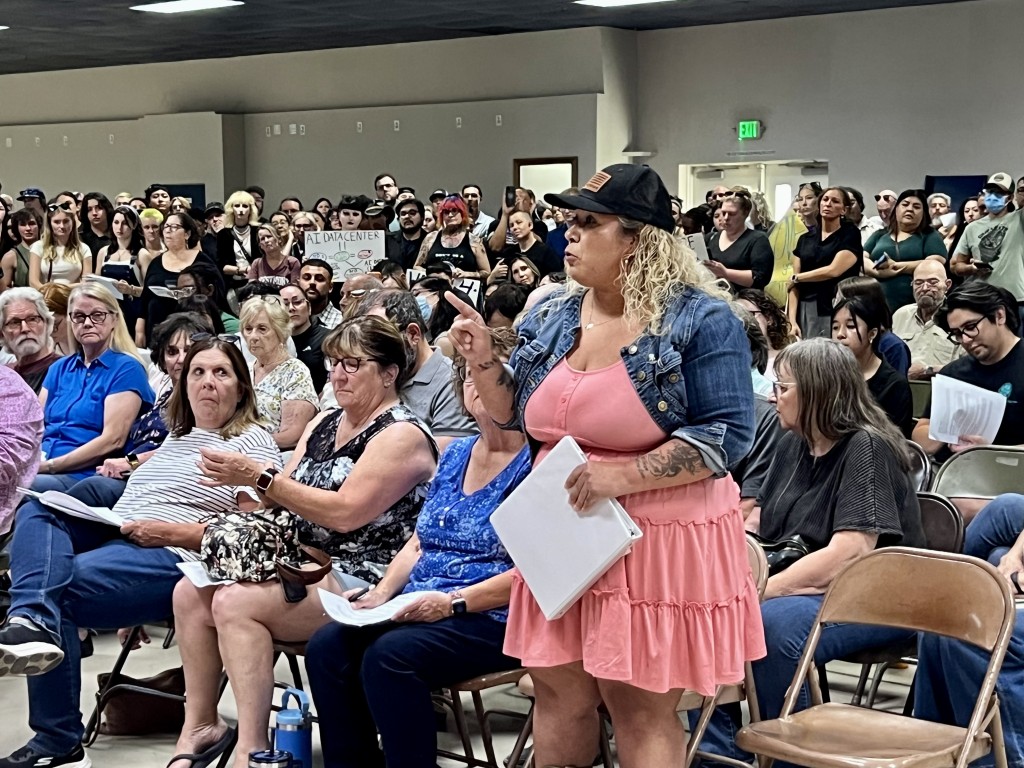
Residents aired a multitude of questions and concerns during several public meetings over two small-scale data centers proposed for the Kings and Tulare county fairgrounds. Because fairgrounds are a separate jurisdiction, these proposed data centers are not subject to permitting requirements and analysis by the county.
So far, no other AI data centers have been proposed elsewhere under Tulare or Kings county jurisdiction, according to county planners.
Pushing pause
Because of the fairground data center controversy Tulare County supervisors will consider an emergency ordinance Aug. 18 to block development of any data centers for 45 days in unincorporated areas, according to Aaron Bock, Resource Management Agency Assistant Director of Economic Development and Planning.
“We are just getting way out ahead of this issue,” Bock said. “Their requirements are far beyond any of our typical energy usage and far beyond any of our typical water usage.”
He said staffers will use that time to develop proposed land use regulations for data centers.
Visalia City Council member Brian Poochigian will also request a data center moratorium discussion at the Aug. 17 city council meeting.
Tulare County isn’t alone in its caution.
The city of Patterson, in Stanislaus County, recently declared a 45-day moratorium on data center proposals.
After approving a 950,000-square-foot AI data center in April, the Imperial County Board of Supervisors walked back its decision following public outcry and declared a 45-day moratorium.
There will be data centers
Meanwhile, AI data centers are already making their way into the valley.
An AI data center is planned at Naval Air Station Lemoore, which is subject to federal approvals and oversight. In September 2025, Ameresco, Inc. announced plans to construct a 100 megawatt AI-optimized data center. The project will offer language model training, real-time analytics and other systems to the base, according to a news release.
Further south, the California Resources Corporation oil company has partnered with Beacon Data Center on a proposed 600,000 square foot AI data center in its Elk Hills oilfield near Taft. It would use 275 megawatts of excess electricity produced on site and employ “water efficient cooling,” according to reports. Though, exactly how much water would be needed hasn’t been released.
A 99-megawatt AI data center has also been proposed for eastern Kern County near the desert community of Inyokern. The center proponent, R&L Capital, Inc., has stated it would only use up to 50 acre feet a year to cool its data halls, according to an application filed with the California Energy Commission in late April.
And the California High Speed Rail Authority has said it may lease some of its right of way through the valley to data centers in order to generate revenue. But there have been no concrete plans or proposals.
There are 296 AI data centers in the state, according to the Data Center Map website.
And nationwide, there are more than 4,000, according to the Brockovich AI Data Center, a crowdsourced data base.
One size does not fit all AI data centers
Global Stack USA, which is behind the Tulare and Kings county fairground proposals, said its data centers are an “edge node” version, about the size of a shipping container – much smaller than hyper-scaled AI data centers that can span across acres.
Edge node centers use closed-loop cooling systems and “do not require a connection to a municipal or community water supply for routine operations,” according to a statement from GlobalStack USA.
If approved, the projects would be subject to environmental review, regulatory approvals and community engagement, according to Global Stack USA CEO Dan Kang.
“Global Stack’s mission is to strengthen California’s emergency resilience by investing in fairgrounds that have long served as trusted community and emergency response hubs. Unlike hyperscale data centers, our model uses compact, modular edge computing as part of a broader resilience platform designed to support critical communications and other time-sensitive functions with a significantly different land, water and energy footprint,” Kang sent in a statement.
“Scaring the public”
The proposed fairground data centers are far from a done deal, Tulare County Fairgrounds and Kings Fair CEO Dena Rizzardo said on Aug. 13.
The fairgrounds and Global Stack USA have signed a memorandum of understanding that she said is a feasibility and fact-finding effort, not a contract.
“There are things in the MOU that are scaring the public, like a 100-year lease,” she said. “I can tell you they won’t get that.”
But fair boards are obligated to consider other sources of revenue for long-term financial stability.
“It’s my job to look at all projects and bring them forth to the board,” she said.
While the next Tulare County Fair board meeting is Aug. 18, Rizzardo said the edge node units won’t be on the agenda for at least six months, as Global Stack USA has yet to submit a formal proposal.
Rizzardo explained entities looking to lease land on fairgrounds for more than five years must go through the state Department of General Services first. Then the proposal can be considered by the fair boards.
Who’s in charge?
A large part of residents’ angst is the lack of clarity on which agencies are in charge of permitting AI data centers.
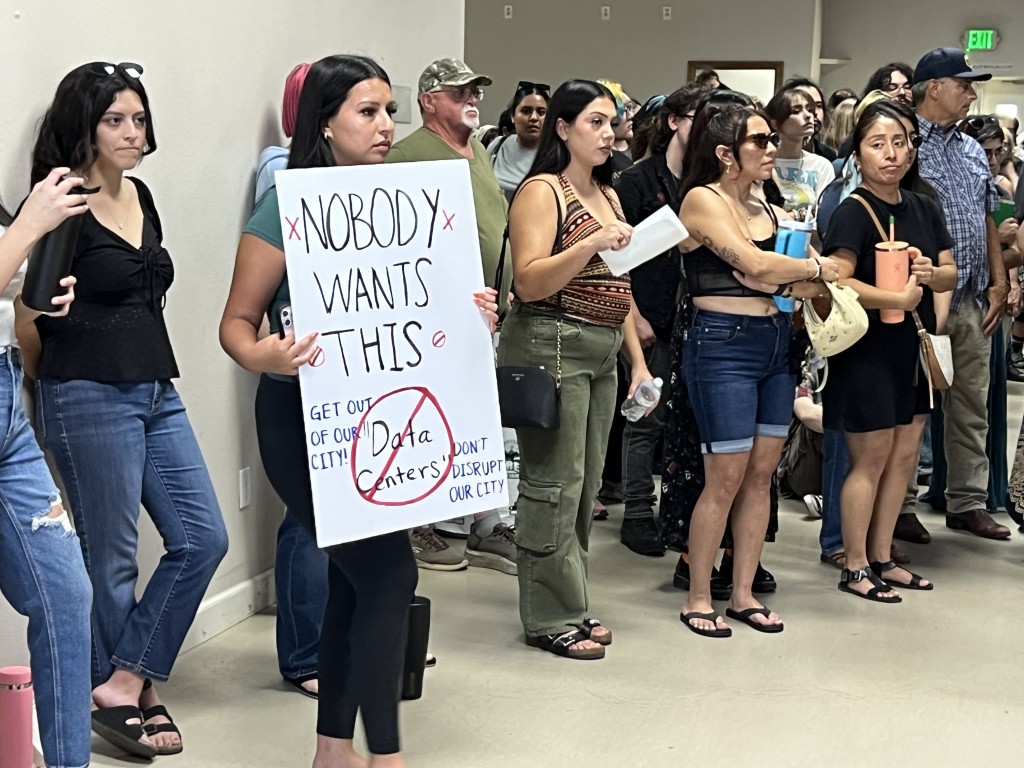
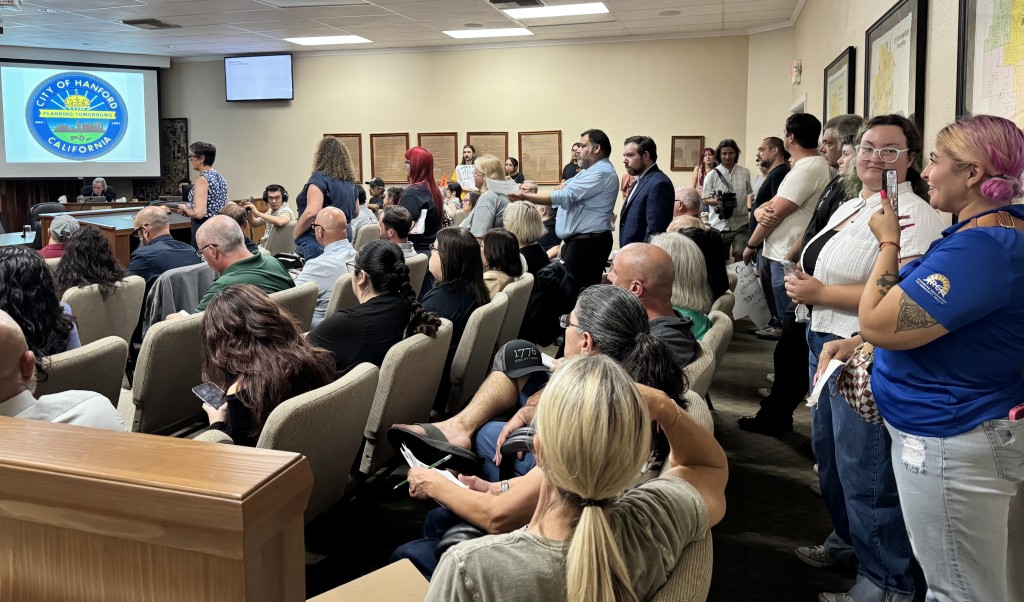
More than 100 residents crammed into the Hanford City Council chambers to make their objections known even after Mayor Mark Kairis told the crowd the city had no authority over the fairgrounds.
He said he wasn’t even aware of the proposed edge node data center until he saw it on social media.
That didn’t stop residents from venting and demanding council members carry their objections further up the chain.
“Go to Sacramento, go to Washington DC and tell them we don’t want data centers, we don’t want flock cameras, we don’t want these things,” said resident Shane Strong.
The situation is similar in Kern’s eastern desert where residents complained bitterly to the Indian Wells Valley Groundwater Authority, which was also on the regulatory sidelines of the proposed Inyokern data center.
In that case, the proposal is first coming under review by the California Energy Commission because the developer, RB Inyokern is seeking an exemption for 44 diesel-powered generators it needs as a back up source of electricity.
This “catch as catch can” approval method may be coming to an end as Gov. Newsom recently tasked the California Public Utilities Commission with developing recommendations on how the state should regulate data centers,CBS Sacramento reported.
Until then, frustrated residents continue bombarding a variety of local boards with their concerns.