State refuses to declare golden mussel emergency because there is no “long-term solution”
Kern County water managers and officials were left scratching their heads after the California Governor’s Office of Emergency Services (CalOES) refused to declare an emergency due to golden mussels because “…there is no identified long-term solution to eliminate or control the continuation of the Golden Mussel Invasion,” according to a letter from CalOES.
Without an emergency declaration, local water agencies aren’t eligible for California Disaster Assistance Act funding to help defray what’s conservatively estimated to be more than $36 million in annual costs to combat the invasive pest.
“I’ve never seen an answer like this,” said Kern County Supervisor Jeff Flores who helped lead the effort to declare a countywide emergency in response to the growing infestation last spring. “I didn’t know a declaration was predicated on known solutions. I thought it was for emergency relief. Our farmers need to be reimbursed for their costs and we need help toward finding a solution.”
At least three other counties, San Joaquin, Sacramento and Yolo, have also declared county emergencies because of golden mussels.
“We’re telling folks to continue tracking your costs and documenting your actions in case future funding becomes available,” Flores said. “We will have a new administration soon and we will continue pressing on this.”
He referred to Gov. Gavin Newsom being termed out, soon to be replaced by Xavier Beccerra or Steve Hilton.
Water managers were similarly perplexed by CalOES’ response.
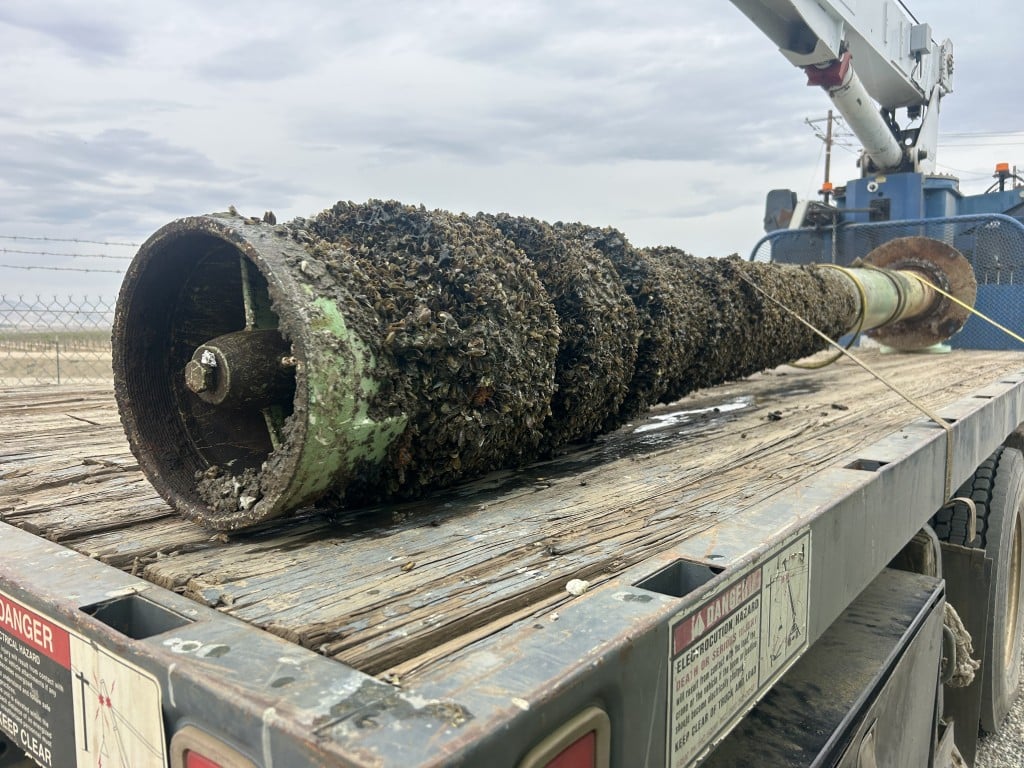
“Disappointing,” said Sam Blue, Resource Manager for Arvin-Edison Water Storage District, which has been combatting mussels since earlier this year. “The state is failing to protect vital infrastructure.”
Others shared frustration at what appears to be CalOES’ inconsistency in what constitutes an emergency.
For instance, the office declared an emergency in September due to possible El Niño-fueled winter storms even though it remains to be seen if El Niño will deliver a wet winter and there certainly aren’t any solutions, long-term or otherwise, to controlling the weather.
If the state won’t kick loose any money, locals hoped that permitting and other regulations could be reduced or streamlined, which was also a part of the El Niño declaration.
Water managers have previously noted that emergency permits for one-time, heavy treatments could be obtained without CEQA review. But ongoing treatment may require study under the California Environmental Quality Act, a time-consuming and expensive process.
SJV Water reached out to CalOES about that and other questions but did not hear back in time for this article.
Meanwhile, the best locals can do is tamp down infestations within their own systems, which has become an expensive ongoing game of Whac-a-Mole for some.
At Wheeler Ridge-Maricopa Water Storage District, water managers recently found new golden mussel infestations in the district’s pipeline system that was mostly mussel free last year, according to General Manager Sheridan Nicholas.
The district has already spent $560,000 treating its canals and will likely have to do additional treatment next year to clear its pipelines, Nicholas wrote in a text.
Because golden mussels are now entrenched in the Sacramento-San Joaquin Delta, there’s no way for local water agencies to eradicate them, as new mollusks arrive with every water delivery through state and federal systems that export from the delta.
Some Kern managers have suggested the state should treat water in the California Aqueduct using a low dose of copper chemicals to kill off veligers, mussel offspring, and provide at least some protection for contractors.
But Gary Pitzer, a spokesman for the State Department of Water Resources, wrote in an email last summer that wouldn’t be feasible.
Even at a modest flow of 3,000 cubic feet per second, the state would need to apply chemicals at 30 stations to cover a 300-mile distance. Chemicals alone would cost an estimated $424 million for just one application, Pitzer wrote.
“There is currently no feasible or cost-effective method for eliminating veligers from the water being conveyed through the State Water Project,” Pitzer wrote in bold and underlined.

Author