Kern water districts officially pledge just 1/3 of state ask for delta tunnel costs
The official tally shows Kern County water districts are only willing to chip in $11.7 million of $33 million requested by the state toward the planning phase of the so-called delta tunnel, according to figures presented at the July 23 Kern County Water Agency meeting.
The agency, which administers the State Water Contract on behalf of 13 local water districts, called “member units,” voted Thursday to approve a funding agreement with the Department of Water Resources that included the reduced amount for planning and pre-construction costs of the 36-foot diameter Delta Conveyance Project.
That leaves DWR with a 20% funding gap in the $300 million it needs for this phase, according to agency General Manager Eric Averett. The state has told SJV Water previously that if Kern’s contribution came in lower than expected it would “… adjust the workload and prioritization accordingly.”
But the $20 billion tunnel would go forward, the DWR spokesperson said.
“Kern county growers should watch their wallets because the state is looking to foist this unpopular project on them at a time when they’re already struggling to make farming pencil out,” said Osha Meserve, an attorney who represents several parties in the Sacramento-San Joaquin Delta that are opposed to the tunnel project.
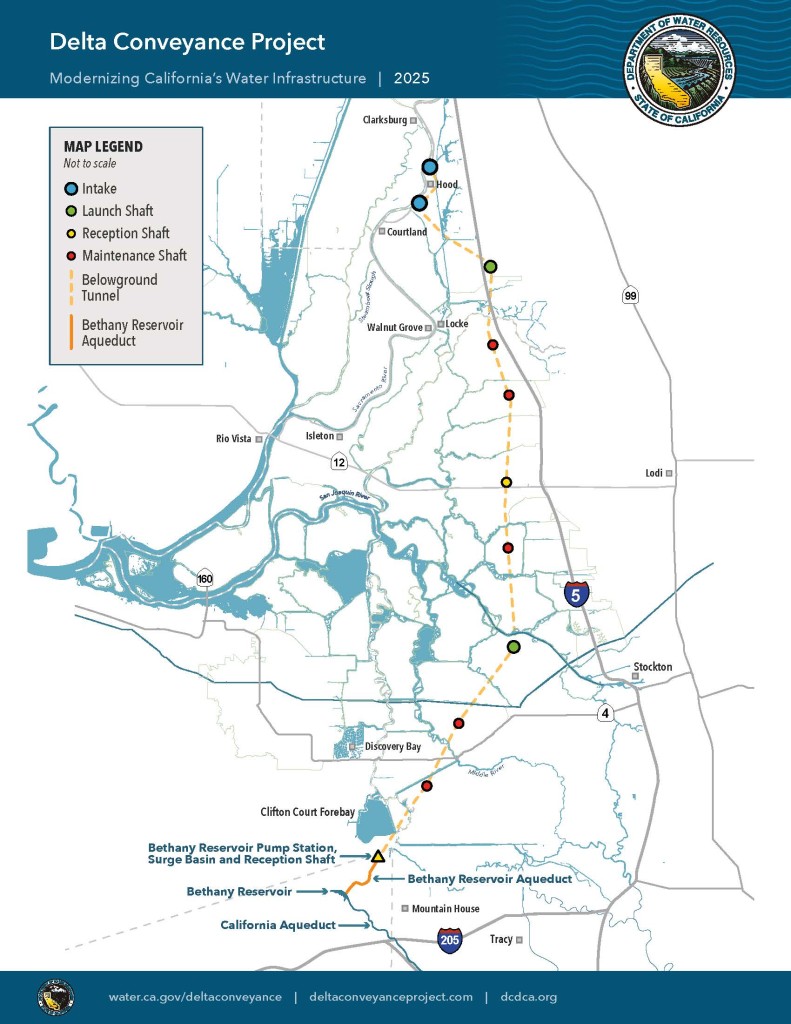
Environmental groups, which have pegged the true tunnel cost at $50 billion, and delta farmers are staunchly opposed to the tunnel which would take Sacramento River water from north of Hood south to pumps near Tracy.
Delta farmers, especially, are concerned that taking significant amounts of clean Sacramento River water will leave them with supplies too salty for crops.
While growers and water managers in Kern have been leery about details of tunnel costs and operations, they generally view it as a necessary project that would bring greater reliability to the State Water Project. DWR has said the tunnel’s primary benefit would be during high water years or if there were a catastrophic event in the Sacramento-San Joaquin Delta, such as an earthquake, that destroyed levees allowing sea water intrusion.
On Thursday, the agency also approved an amended funding agreement with DWR so that if water costs exceed $55 per acre foot the agency’s (and its member units’) contribution toward tunnel construction will be reduced and a portion deferred. In addition, the agency is seeking “off ramps” that allow it to pause or cease payments entirely if the project has significant changes or runs into insurmountable hurdles.
DWR has yet to sign off on the amended funding agreement. The agency incorporated those same alterations into a new funding agreement with its member units, which is under consideration by the districts.
Questions about operations and affordability are what prompted Kern water districts to reduce their support over the last year.
In March 2025, districts had opted to support the tunnel at a level up to nearly 45% of the water they contract with the state for. That dropped to 16% this year.
Districts had to decide how much they wanted to chip in based on a percentage of their contracted water supplies that they expect to rely on the tunnel to receive. It’s similar to the government asking drivers to pay ahead of time to build a road based on the frequency each driver expects to use that road. If they don’t pay, they can’t use the road.
In the case of the delta tunnel, Kern districts are holding on to the equivalent of a bike-lane-sized share.

On Thursday, agency board member Gene Lundquist also asked “Where’s Met on this?” referring to the giant Metropolitan Water District of Southern California, the largest contractor on the state project.
Averett said that while MWD has similar concerns about how the tunnel will be operated, it has signed its own funding agreement with DWR. An MWD spokesperson told SJV Water the district had committed in 2024 to paying $141.6 million toward planning and pre-construction and has so far paid $25.7 million of that.
“We still need clarity on operations and the rules of use,” Averett said Thursday, adding that an in-person meeting with contractors and DWR is scheduled for Aug. 13.
Author