Kern water districts slash support for delta tunnel to a third of 2025 levels
Financial support for the planning phase of the Sacramento-San Joaquin Delta tunnel has plummeted among Kern County agricultural water districts as they continue to seek definitive answers about water supplies and how the tunnel will operate.
The Department of Water Resources (DWR) had been seeking $33 million from Kern districts to be paid in two installments this year and in 2027 for the planning and pre-construction phase of the tunnel, known as the Delta Conveyance Project.
But it will get considerably less than that based on participation levels that districts have approved during recent meetings.
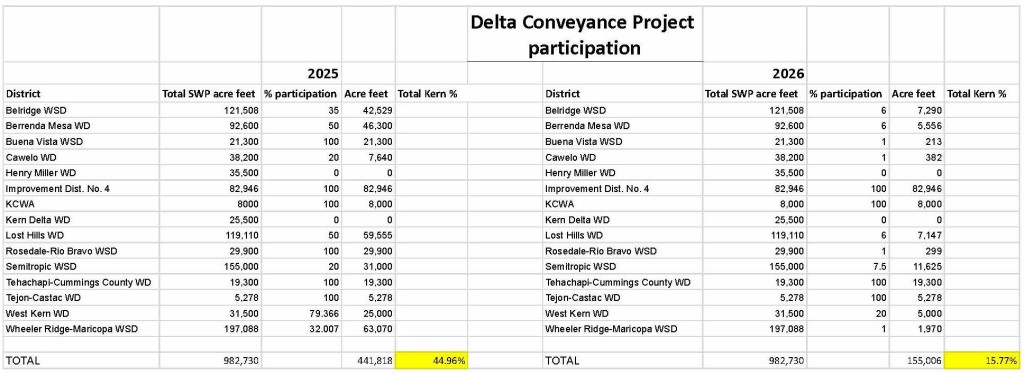
In March 2025, Kern districts had opted to participate – and fund – tunnel planning at 44.96% of the county’s total State Water Project (SWP) contract.
That appears to have dropped to 15.77%, according to recent board meetings.
Kern districts are being asked to decide how much they want to chip in toward the tunnel based on a percentage of their contracted water supplies that they expect to rely on the tunnel to receive.
It’s somewhat akin to the government asking drivers to pay ahead of time to build a road based on the frequency each driver expects to use that road. If they don’t pay, they can’t use the road.
In the case of the delta tunnel, Kern districts are, basically, holding to a bike-lane-sized share.
“We may consider increasing after 2027, if key project milestones are met,” Greg Hammett, general manager of the West Kern Water District, wrote in an email explaining the district’s reduced participation levels..
The same for other districts.
For instance, the Wheeler Ridge-Maricopa Water Storage District in southern Kern County contracts with the state for 197,088 acre feet a year. Last year, it had agreed to pay a share of the tunnel planning costs for 32% of those contracted supplies, or 63,070 acre feet a year. The total over 2026-2027 would have cost the district $4.1 million.
But earlier this year, the Wheeler Ridge board decided to drop its participation to just 1%, or 1,970 acre feet, which will cost $146,000 over 2026-2027.
Support from Kern, which is the second largest contractor on the State Water Project, has been dropping primarily because local water managers have said they can’t get solid information about how the tunnel will operate and how much water they can count on under different hydrological conditions.
They had hoped to nail down answers to those questions in a funding agreement from DWR.
A draft funding agreement is currently making the rounds that does answer some questions, but not all, according to managers who declined to share the document as it’s still in draft form.
Kern Water managers have said they support the delta tunnel in concept but with so many other costs coming at farmers these days, they need a firm bottom line on the water return.
“There’s only so much money to go around,” Semitropic Water Storage District General Manager told Jason Gianquinto told SJV Water for a previous story on this issue.
The reduced support will likely be a significant hit to tunnel funding for this phase, but a DWR spokesman said by email that the project will proceed.
“We are still working out the final details of funding arrangements for Kern County Water Agency (districts),” the spokesman wrote. “If their (districts) make contributions lower than anticipated, we will adjust the workload and prioritization accordingly.”
The Kern County Water Agency holds the contract with DWR on behalf of 13 mostly ag districts, which are called member units.
A final participation and funding tally for the tunnel will be discussed at the Kern County Water Agency’s July 30 meeting.
A larger issue that many local managers are closely watching, is whether DWR can bond for bulk of the tunnel’s construction costs, expected to be $20 billion, though environmental groups peg the true full cost at closer to $50 billion.
An appeals court ruled against the Delta Conveyance Project’s bond validation action.
Even so, the DWR spokesman said the department “…still plans to issue bonds to finance the project.”
He explained that DWR has “…existing statutory authority under the Central Valley Project Act to plan, finance, and construct water supply infrastructure. The Third District Court of Appeals’ ruling did not hold that DWR lacks the authority to plan, finance, and construct the Delta Conveyance Project. Instead, the court held that DWR’s 2020 bond resolutions were overly broad.”
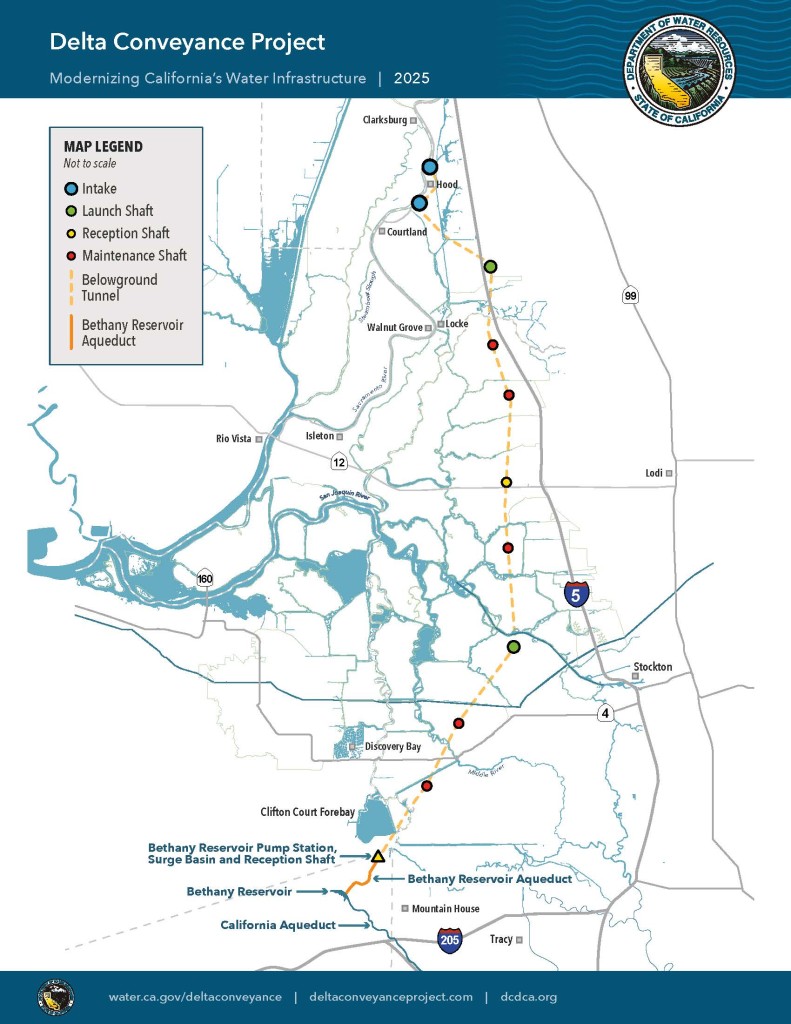
The Delta Conveyance Project anticipates building a 36-foot diameter tunnel to bring Sacramento River water from just north of Hood 45 miles south beneath the ecologically sensitive delta to the Bethany Reservoir. The goal is to increase system resilience and avoid trapping endangered fish in the southern end of the delta.
Environmental groups argue that depriving the delta of fresh river water will cause it to become overly salty, destroying the local farm economy, among other issues.
• This article was updated on July 9 to correct the DCP tunnel diameter. LH

Author