Tulare water managers brace for state action on excessive groundwater pumping
While water managers in southern Tulare County aren’t rolling out the welcome mat for Thursday’s meeting with state regulators, they are curious about how the state may propose to ratchet down overpumping.
The meeting is invitation-only between water managers, Water Resources Control Board member Nichole Morgan and high-level state staff. It is not open to the public. Even groundwater agency consultants and attorneys aren’t allowed.
An agenda obtained by SJV Water shows state staff will lay out components, timelines and procedural steps for the next phase in the state’s crackdown on excessive groundwater pumping.
Staff will also propose actions the 12 Tule groundwater sustainability agencies (GSAs) could take to prevent state-mandated pumping limits, which will also come with a charge of $35 per acre foot.
Possible state-mandated pumping limits are the next consequence of locals not being able to draft a cohesive groundwater plan that protects water quality and stems rampant subsidence.
Local managers had nearly two years to come up with such a plan after the region was placed on probation in 2024. But a new plan has, so far, not materialized.
Reactions to the state’s agenda for Thursday’s meeting ranged from disdainful to hopeful among farmers and water managers.
“Is this just going to be a kick in the ass?” Pixley farmer Mike Faria asked at a Tule subbasin stakeholder meeting Wednesday.
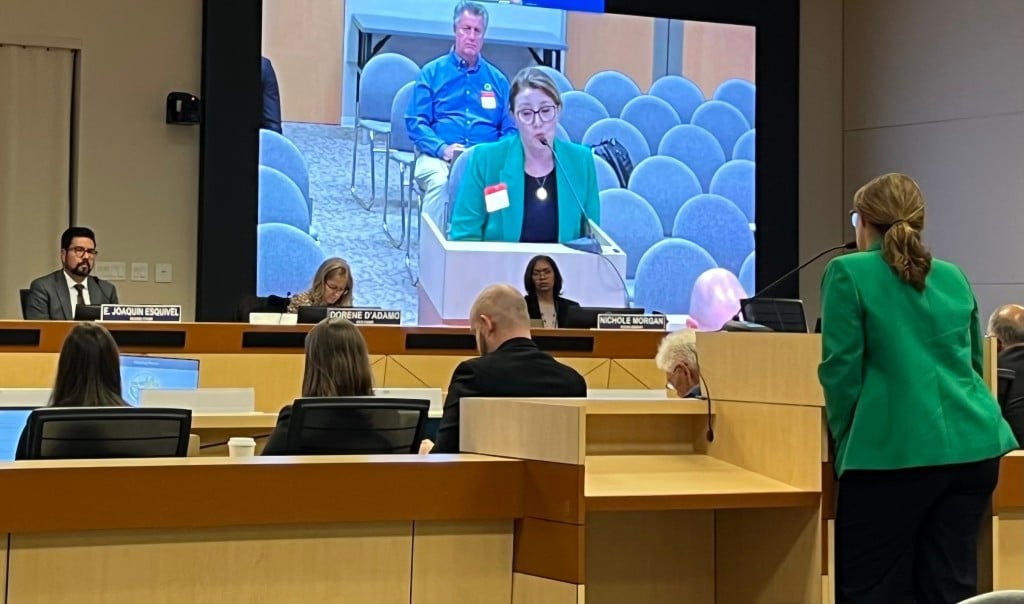
Others noted some positives on the state agenda, including that Natalie Stork, director of the Office of Sustainable Groundwater Management, will review expectations for consulting with Water Board staff.
“And that’s great, because there hasn’t been a ton of communication with state board staff,” said Tule subbasin manager Don Tucker. “We’re going to learn a lot even though we have no expectation of how it’s going to go.”
A lack of communication with the state has been a common complaint, with managers saying Water Board staff are operating “in a silo” and not answering questions.
Garbled or nonexistent communication may be what led to rumors that Water Board staff allegedly felt Thursday’s meeting could be unsafe.
The rumors apparently stemmed from a question about the anticipated “tone” of the meeting asked by meeting facilitator Kearns & West, which spoke with each GSA manager and a board member in advance of the meeting.
That got filtered down to Tule stakeholders as concerns the meeting would become hostile.
“What do they think, that we come to meetings with guns and knives?” said Matt Leider, president of Tea Pot Dome Water District GSA, at the GSA’s July 8 board meeting.
A Water Board spokesman wrote in an email that there were no concerns about security.
Strife, whether internal or external, is not the message the region needs to send, said Alex Peltzer, Tea Pot Dome’s manager and the General Manager of Pixley and Lower Tule River GSAs.
“But it’s important for us to let the state board know that whatever the differences we have amongst each other, we are working them out.”
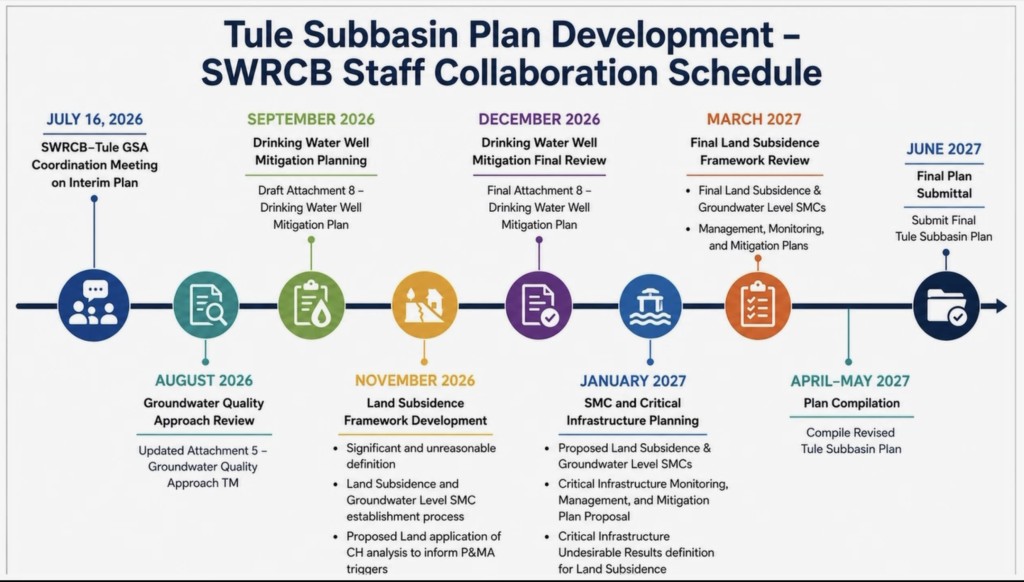
A presentation to be shared on Thursday by Tucker aims to do just that.
It outlines three common priorities: subsidence, groundwater quality and domestic well protection and gives timelines for achieving each.
Negotiations with Friant Water Authority over how to protect the critical Friant-Kern Canal are ongoing, Tucker said. That may include zero pumping along a two or three-mile zone on either side of the canal through the subbasin.
The subbasin plans to submit a rewritten groundwater sustainability plan by June 2027.
Since the 2024 probationary ruling, the subbasin’s six GSAs split into twelve. Lawsuits over damage to the Friant-Kern Canal from overpumping erupted between multiple GSAs and Friant Water Authority.
And excessive, “wild west” overpumping continues in the former Eastern Tule GSA, where a lapse in oversight means there are no rules in play.
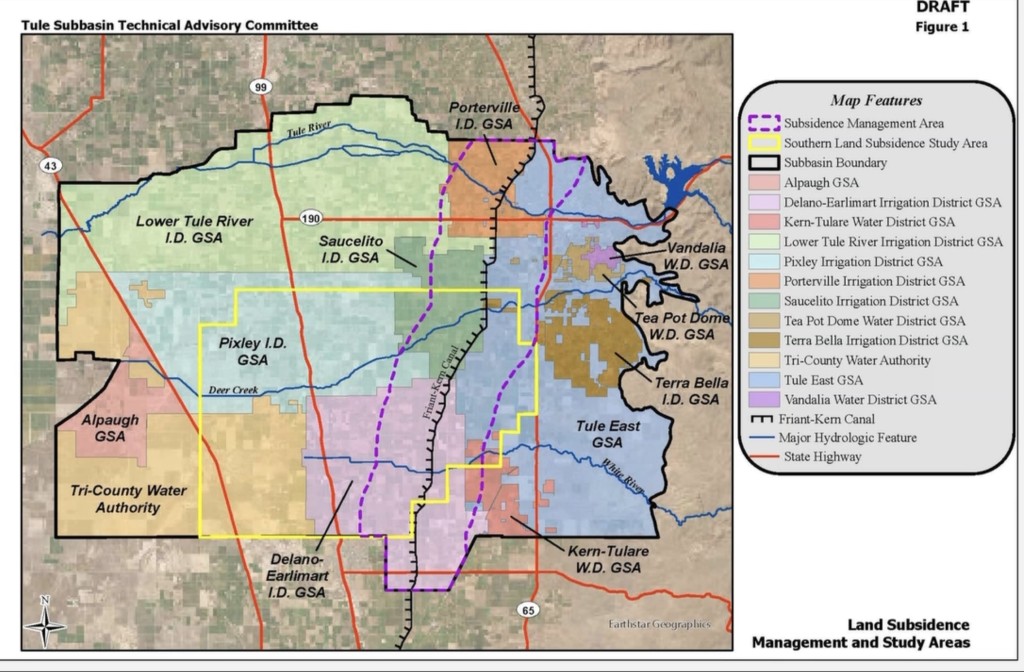
In the last several months, a policy group has been meeting every other week to hammer out contentious subsidence management details, 11 of 12 GSAs have signed on to a unified groundwater plan effort and all 12 GSAs have signed on to a subsidence study that will lay out exactly where and why subsidence is occurring.
Tucker said 52 technical and policy meetings have been held since April.
“The point is there is a lot of work that is happening right now,” Tucker said. “We’re trying to get to the point where state board staff can see the effort that is going into it, and we can let them know we’re serious about this.”