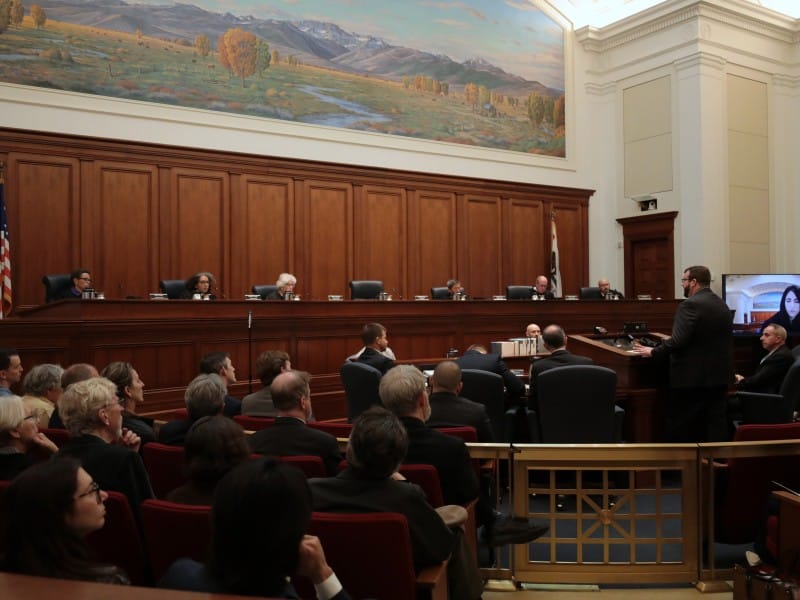
State’s high court to hear Kern River case in Redding next month
California Supreme Court justices will hear oral arguments on a key piece of the ongoing lawsuit over Kern River flows Oct. 7 at a special session of the court to be held in Redding.
The hearing will begin at 9 a.m. at the University Preparatory School, 2200 Eureka Way. Those interested in attending may want to get a seat early as this is part of the court’s student outreach program so local high school students and teachers will fill much of the venue. The proceedings will also be broadcast via livestream at https://supreme.courts.ca.gov/. Archives of the hearings are typically posted to the court’s webpage two weeks to a month later.
The last time justices ruled on a case involving the Kern River was 140 years ago. That 1886 ruling set the basis for California’s water rights system.
This time around, the outcome could be just as weighty.
Justices are looking at whether the 5th District Court of Appeal erred when it overturned a temporary injunction by Kern County Superior Court Judge Gregory Pulskamp issued in fall of 2023 after an epic water year filled the mostly dry river bed through town – bringing fish with it.
That injunction had required the City of Bakersfield, which operates the river, to keep some water in the river based on California Fish and Game Code Section 5937, which requires dam owners to let enough water run downstream to keep fish in good condition.
But the city, and several agricultural water districts with river rights, said Pulskamp should have first determined how much water was needed by fish and then weighed that need against other needs to determine if it was reasonable and beneficial, as is required by Article X, Section 2 of the California Constitution.
The plaintiffs, Bring Back the Kern, Water Audit California and several other public interest groups, argued that 5937 is unambiguous and that it was enacted in furtherance of Article X, Section 2, thereby, making water for fish an automatically reasonable and beneficial use.
The Fifth District Court of Appeal sided with Bakersfield and the ag districts and overturned Pulskamp’s injunction in April 2025. The plaintiffs, then, appealed to the Supreme Court, which agreed to hear the case in July 2025.
Because Fish and Game Code 5937 has been used in several other river conservation cases throughout California, this case has been closely watched by numerous environmental groups and the Attorney General’s office, which filed “friend of the court” briefs in support of Pulskamp’s interpretation of the law.
A Supreme Court ruling could uphold or upend decades of river conservation case law.
Attorneys for all sides did not comment, other than to say they are still working out logistics on who will make arguments for which entity.
Typically, each side has 30 minutes to argue but the ag districts, which aren’t defendants but are considered “real parties in interest” to the case, have filed a motion to get their own 30 minutes.
Attorneys for Bring Back the Kern and Water Audit California and Bakersfield have opposed that motion, which justices have yet to rule on.
After oral arguments on Oct. 7, the Supreme Court has 90 days to issue its written opinion. If either side is dissatisfied with that ruling, the only other next step would be the U.S. Supreme Court.
Back in 1886, when the Supreme Court ruled that riparian rights trumped appropriative rights, combatants Henry Miller and James Ben Ali Haggin could have taken it up to the U.S. Supreme Court. But after more than 10 years of legal battles, they were tired of fighting and cut a deal instead.
For part of the year, Miller would get 1/3 of the river’s flow delivered to his lands west of Bakersfield. The rest of the year, Haggin and other upstream users would divvy up the rest. That 1888 Miller-Haggin agreement remains in place to this day as a foundational document governing how the river is operated.
Depending on how justices rule this time, the underlying lawsuit that spawned the injunction testing Fish and Game Code 5937 could move forward as is, or change substantially.
Right now, trial in that case is set to begin Oct. 4, 2027.
Author