Portable dam used in $800,000 upgrade on historic Fresno canal headgate
• Editor’s note: Allison Hunter covers Fresno County water issues for SJV Water through the California Local News Fellowship initiative.
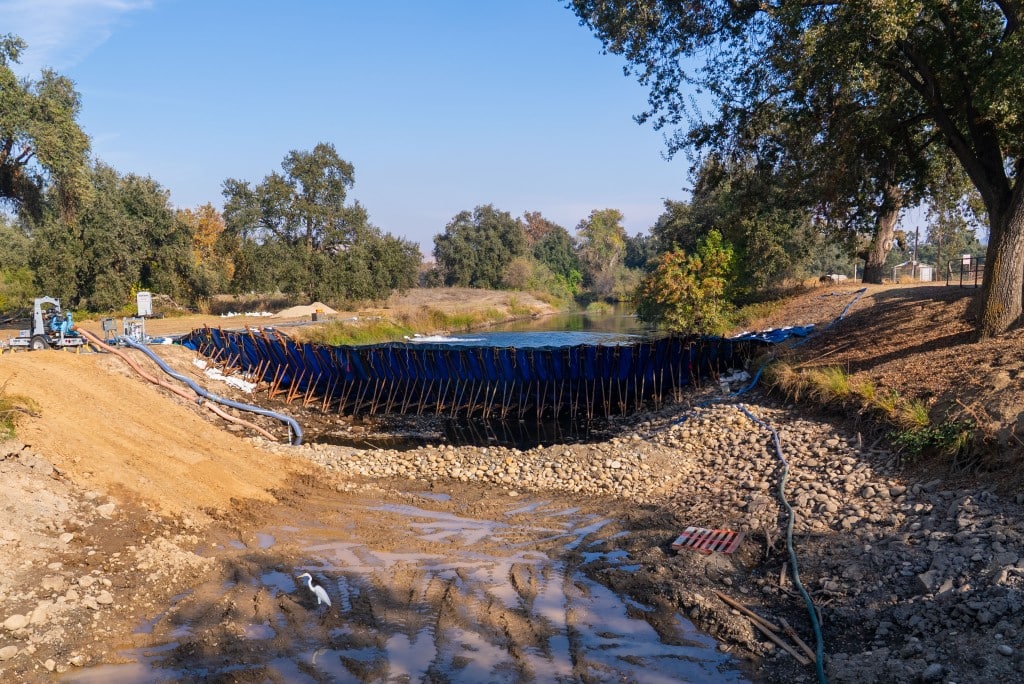
In a first for the Fresno area, a “portable dam” is being used to hold back water for an $800,000 upgrade at the Fresno Irrigation District’s (FID) main Kings River headgate on the Fresno Canal.
FID contracted with a New Jersey company called Portadam that, true to its name, deploys a portable dam in waterways, as needed, said Adam Claes, FID’s assistant general manager of operations.
It has been used in revamping FID’s more than 100-year-old headgate at the Fresno Canal, bringing it into the 21st century with stainless steel motor-operated gates.
In order to get the work done, FID needs to hold back the water, which is where Portadam comes in.
The portable dam is made of a row of metal A-frames, roughly 10 feet tall, that sit on the channel floor. A tarp over the frames is held in place with sandbags.
The Portadam stretches about 90 feet across the canal, explained Claes.
Using this method is “less intrusive to the channel,” Claes said, than building a temporary dam out of cobble, or large, round river stones.
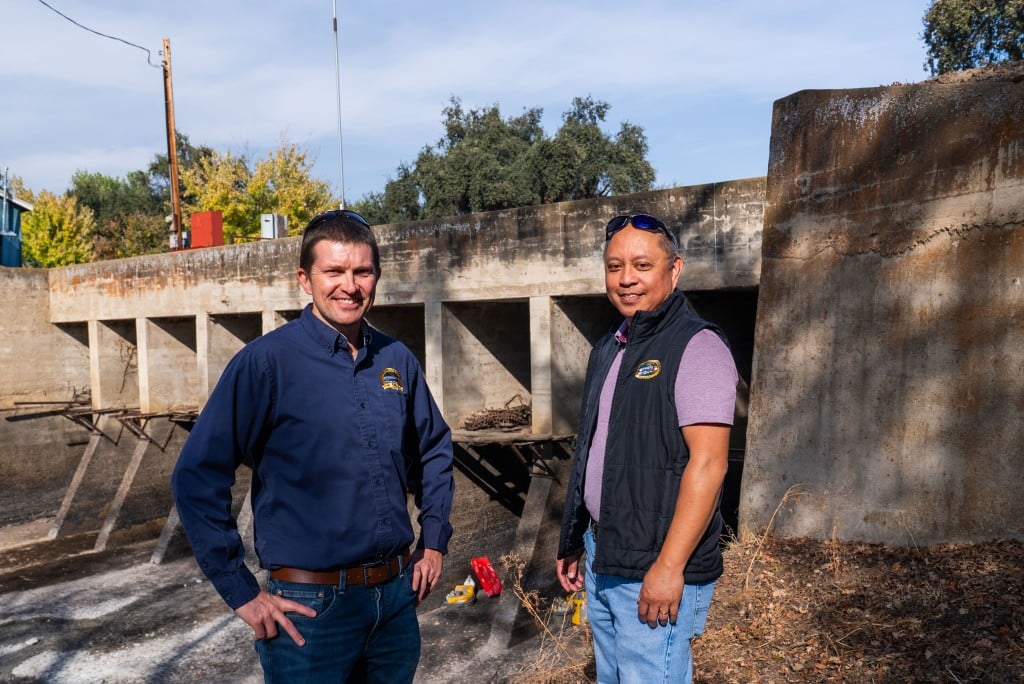
The district has a cobble stockpile but was not sure if “it was big enough, because we’ll use it for erosion control measures and other canals throughout FID,” he added.
The district would have needed “several dump trucks” of cobble and “an excavator to reach out and dump the rock in [the canal], and then eventually a bulldozer to compact it down,” Claes said.
Portadam won’t need any of that. Using the portable structure has also freed up staff time, Felix Vaquilar, chief engineer of FID said, allowing them to focus on other projects, such as preparing for potential heavy storms this winter.
“With it being an El Niño year,” Claes said, “we’re going to be ready to take any kind of flood control or flood releases that are available if it happens, so we don’t want our main canal down during that time.”
The entire headgate project was expected to be completed by Nov. 25, Claes said.
With a nod to the headgate’s historic significance, Claes noted it is part of FID’s logo. It was built back in 1905 by the Fresno Canal and Irrigation Company before FID bought it in 1920.
“There’s not one crack in it,” Claes said.
The metal gate system, however, has changed over the years, Claes said.
The original headgate had custom cast iron gates that the district later replaced with epoxy-coated steel, district staff said. The steel rusted over time and occasionally jammed when a tree got stuck underneath, staff said.
A modest sky-blue house on the embankment was used by a resident employee who would manually adjust the flow rate at the headgate, Claes said. It’s still rented out by FID and residents “check on things” in case the communication system goes down.
Before the district used electric motors, a water wheel system powered the gates, Claes said, pointing to rusty chains and gears still inside the structure.
When the district added two motors more than eight decades ago, the motors controlled the gates in two groups, not separately.
That setup stayed in place “basically until a week ago when we started tearing everything apart,” Claes said during the Oct. 27 tour.
After this upgrade, Claes said, “We’re going to have individual motors for every gate so we can control each one independently.”
“It’s the modern way of doing it,” Claes said.