Kings County groundwater lawsuit against the state hangs in the balance
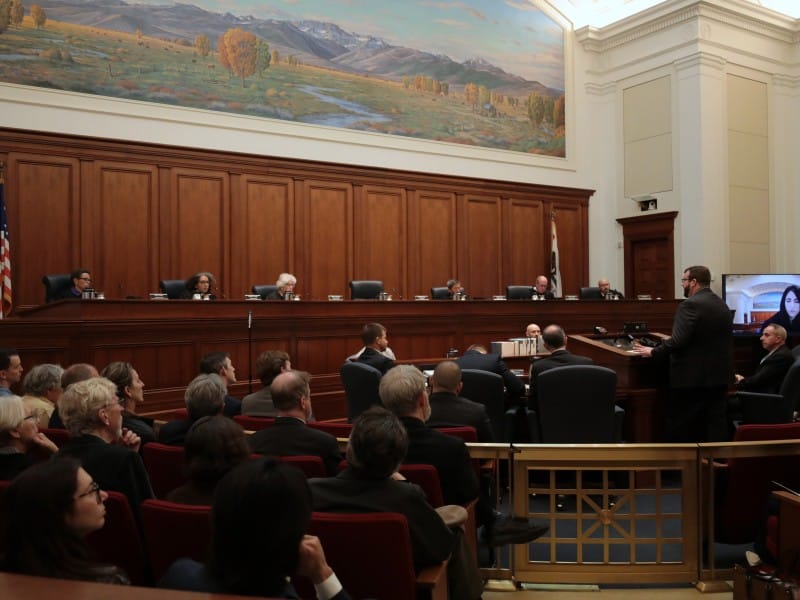
A Kings County judge will determine whether to issue a second preliminary injunction barring the Water Resources Control Board from charging farmers pumping fees and if the underlying lawsuit against the state should move forward or be dismissed after a hearing that stretched over two days last week.
The Water Board and Kings County Farm Bureau faced off for lengthy hearings held Oct. 6 and 7, arguing about pumping fees and whether the state acted outside its authority when it placed the region on probation in April 2024.
Kings County Judge Robert S. Burns took the matter under submission. His ruling could have major implications for farmers in the Tulare Lake subbasin, which covers most of Kings County.
This latest legal skirmish stems from an ongoing lawsuit by the Farm Bureau filed in 2024 alleging the Water Board overstepped its authority when it placed the Tulare Lake subbasin on probation earlier that year.
It had won a preliminary injunction holding pumping reporting requirements and fees at bay for more than a year, until that injunction was mostly overturned in Oct. 2025 and the case returned to Kings County.
Burns ruled in August that the Water Board could begin charging most farmers $20 per acre foot pumped. Those invoices are expected to arrive in mailboxes by the end of the year.
He also ruled that farmers in two local groundwater agencies were exempted from those fees as well as a requirement to report their extractions to the state.
In its latest bid for an injunction to protect farmers in all Tulare Lake subbasin groundwater agencies from those pumping fees, the Farm Bureau argued that they are unconstitutional.
Farm Bureau Attorney Valerie Kincaid said the $20-per-acre-foot fee unfairly burdens farmers in Kings County with state oversight costs that include more than just the Tulare Lake subbasin.
The state Water Board has said it needs $5.5 million a year to pay for oversight costs. That includes evaluating voluminous technical documents and plans, maintaining and overseeing the online portal where farmers report pumping, and more.
But Kincaid said that based on projected extractions in the Tulare Lake subbasin of 502,710 acre feet, the Water Board would collect $10 million from Kings County farmers alone.
“Kings County residents should not be shouldering the cost for the entire state, but If they were to do so, the state Water Board tells you it needs $5.5 million from them and they’re going to collect $10 million,” Kincaid said.
Kincaid added that the Water Board is only charging fees in two subbasins placed on probation – Tulare Lake and the neighboring Tule subbasins – though the board had worked extensively with four other subbasins that ultimately avoided probation.
Judge Burns, himself, stepped in saying the state has authority over all counties and regions in California with regard to regulatory fees.
“…So that those who pump the most, those who are having the largest impact on the environment are the ones that are paying the greater share, which would seem to me to be the bedrock of allocation,” Judge Burns said.
The Farm Bureau also argued against the Water Board’s probationary designation for the Tulare Lake subbasin in 2024 saying the board hadn’t properly consulted with the Department of Water Resources (DWR).
DWR provided initial oversight of groundwater plans. Once a plan was deemed inadequate, however, the subbasin came under authority of the Water Board, which is the enforcement arm of the Sustainable Groundwater Management Act (SGMA).
Kincaid pointed to two emails that showed a back and forth between the state agencies but no evidence that the two actually met to discuss intervention.
Water Board Attorney Margaret Tides responded that the probationary designation was arrived at after detailed analysis of each of the subbasin’s five groundwater sustainability agency plans, which Water Board staff determined did not demonstrate the region would attain sustainability by 2040 as required under the law.
“The record reflects an analysis of every single portion of this subbasin in detail and it reflects that the board identified numerous deficiencies that precluded exclusion in these areas,” Tides said.
Kincaid also argued the Water Board had failed to apply the law appropriately when it declined to consider exemptions for individual groundwater agencies within the subbasin that could show they weren’t over pumping.
In fact, the 5th District’s 2025 ruling found the Water Board had erred by not evaluating each agency’s plan on its own merits and instead lumped them all into a single probationary pot.
The Water Board did eventually exempt Tri-County Water Authority and Southwest Kings Groundwater Sustainability Agency GSA under the “good actor” clause in March.
Probation requires farmers to meter their wells and register them annually at $300 each. Farmers are also required to report pumping to the state and pay $20 per acre foot pumped. That fee would go up to $35 per acre foot if the state rejects the region’s new groundwater plan, which is expected to be completed and submitted by April 2027.