Farmers should seek state’s help with upcoming groundwater reports
If farmers need help navigating the state’s online portal to report groundwater pumping, that will be between them and the state, some groundwater agencies have said.
Walking farmers through the state’s pumping portal, also known as GEARS, during the last reporting period took way too much time and effort, said Travis Millwee, Resources Manager at Lower Tule River Irrigation District Groundwater Sustainability Agency (GSA).
“Moving forward, the GSA is gonna have to take a step back from reporting for its landowners,” Millwee said at an Oct. 13 GSA meeting.
Millwee said Lower Tule incurred significant overtime as staff helped up to five landowners a day work through GEARS so farmers could meet the state’s last reporting deadline. The GSA was inundated with calls, taking staff away from regular tasks.
“Landowners are gonna have to get in a more direct relationship with the state Water Board and make sure they’re prepared to (report) again next year,” he said.
Part of the problem was that GEARS was widely criticized as clunky and hard to navigate during the first round of mandatory reporting for farmers in the Tulare Lake and Tule subbasins earlier this year.
Farmers in those subbasins, which cover most of Kings County and the southern half of Tulare County’s flatlands, respectively, must report extractions to the state as a consequence of the regions being placed on probation for lacking adequate groundwater protection plans.
Mid-Kings River GSA General Manager Chuck Kinney gave similar advice to that GSA’s landowners – call the state for help.
“As far as sitting down with property owners to walk them through the process of GEARS, they’ll need to attend those state workshops,” Kinney said during an Oct. 19 grower advisory meeting.
He added that farmers could export extraction data from the GSA’s pumping platform.
Farmers will also need to adhere to a new reporting requirement if they are submitting extractions based on evapotranspiration (ET, how much water plants take up and expire), shifting from reporting per parcel to per well.
Amer Hussain, engineering consultant for Mid-Kings also said at the Oct. 19 meeting that landowners would need to calculate estimates for each well.
The Water Board is working on updating its user guide to reflect those ET reporting changes.
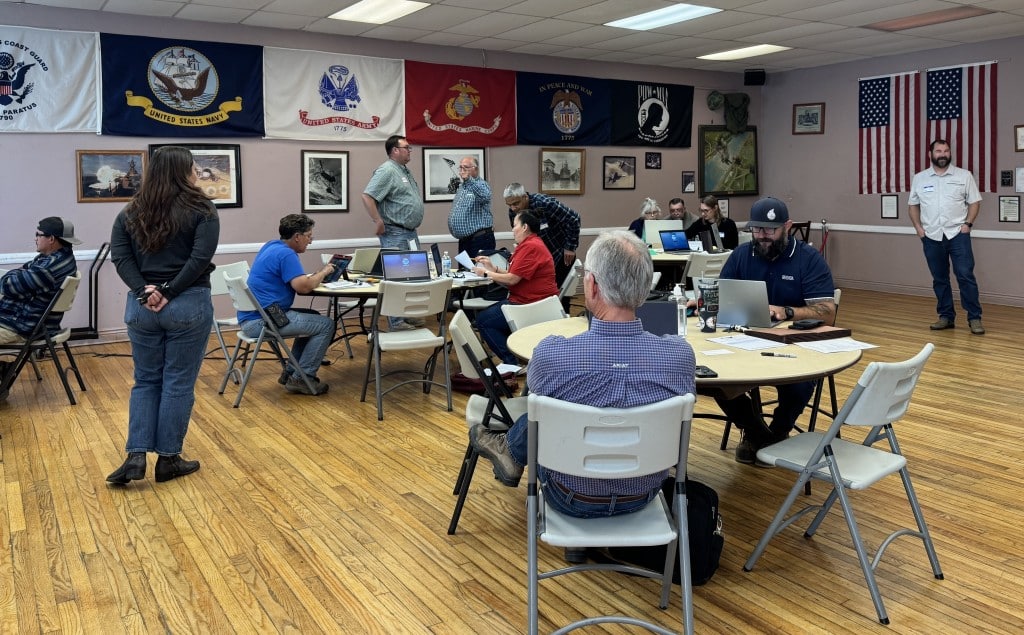
It will also hold a series of workshops to help farmers with reporting:
- Nov. 17, 2026, 10 a.m. to 1 p.m., Veteran’s Memorial, 1000 Van Dorsten Ave., Corcoran
- Nov. 18, 2026, 9 a.m. to 2 p.m., Porterville Veteran’s Memorial, 1900 West Olive Ave., Porterville
- Dec. 9, 2026, 10 a.m. to 1 p.m., Pixley Branch Library, 927 South Center St. #B, Pixley
- Dec. 9, 2026, 4:30 p.m. to 7 p.m., Allensworth Elementary School, 3320 Young Rd., Allensworth
- Dec. 10, 2026, 9 a.m. to 2 p.m., Lemoore Veteran’s Hall, 411 West D St., Lemoore
Individual virtual appointments also will be available in November. More information will be available closer to that date.
Farmers may start reporting extractions Nov. 2 with a deadline of Feb. 1, 2027.
Tule farmers must submit extractions from Jan. 1 through Sept. 30 while Tulare Lake farmers must submit extractions from Oct. 1, 2025 through Sept. 30.
Farmers who pump less than 20 acre feet per year are excluded from having to report extractions.