California law aimed at saving groundwater risks crushing state’s small farmers, according to report
• Freelance for SJV Water
Small farmers in the San Joaquin Valley are struggling with groundwater regulations to the point that 85% of 170 farmers surveyed for a recently released report said they were concerned they would have to shut down.
Others said they are “cutting their farms in half, or more,” said Alyssa DeVincentis, one of the report’s authors, with the Community Alliance with Family Farmers, during a webinar held August 3 to discuss the “Managing Groundwater With Small Farms in Mind” report.
“They’re actually reducing the amount of food that they’re producing,” DeVincentis said.
That’s a very real and substantial impact of how the Sustainable Groundwater Management Act (SGMA) is affecting small farmers, she added.
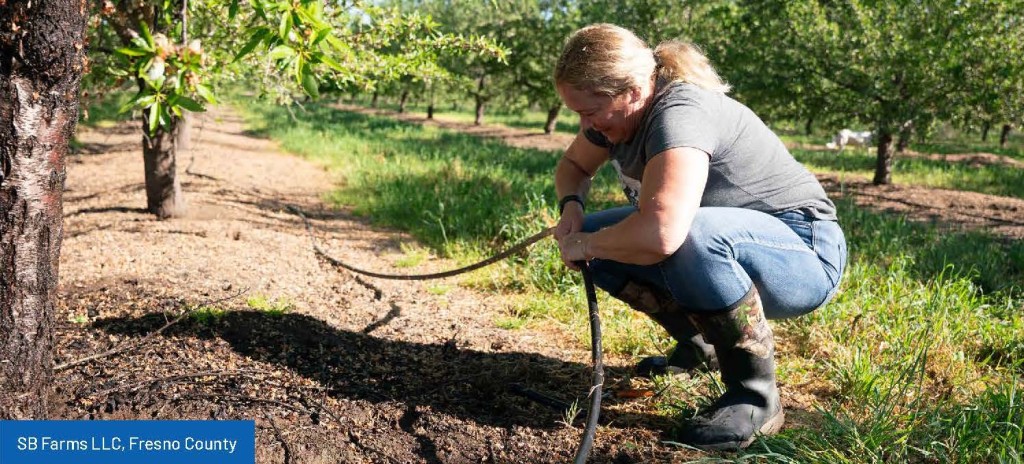
California enacted SGMA to prevent aquifers from drying up in the state’s most overtapped groundwater basins. It mandates that local agencies, Groundwater Sustainability Agencies (GSAs), develop plans to stop six “undesirable results” associated with withering aquifers, such as subsidence, worsening water quality and plummeting water tables.
The report argues the loss of small farms is a seventh undesirable result. This loss comes partly from how “groundwater management is designed and implemented,” said Ngodoo Atume, an academic coordinator with UC Agriculture and Natural Resources and one of the report’s authors, during the same webinar.
Larger farm operations don’t feel the brunt of SGMA implementation as severely, despite having a far greater impact on groundwater depletion, according to the report. SJV Water recently reported on this imbalance affecting farmers in Madera County.
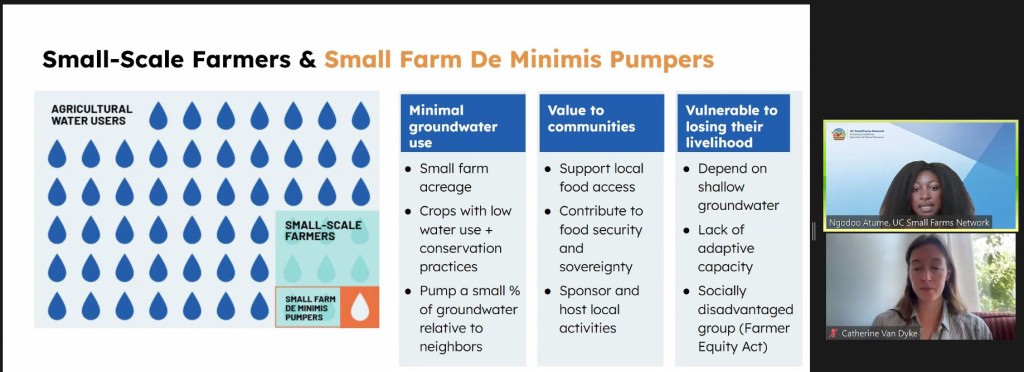
“In the critically overdrafted Tule and Tulare Lake subbasins, over 40% of pumpers account for only 1% of total water use,” the report states.
Yet, that 40%, which researchers argue is made up mostly of small farmers, is subject to the same pumping cutbacks and fees as larger, better resourced farms.
For instance, GSAs often charge fees based on how much farmers pump.
In some cases, these fees can be as high as $500 per acre foot in the valley’s most critically overdrafted basins, with significant penalties for pumping over a farm’s allocation. In one modeled example, the report shows a $300-per-acre water cost eating up 94% of a 10-acre farm’s profit compared with 34% for a 1,000-acre farm’s profit.
The report is the product of three years of research by the California Alliance with Family Farmers and University of California, Small Farms Network, which is part of the UC Agriculture and Natural Resources.
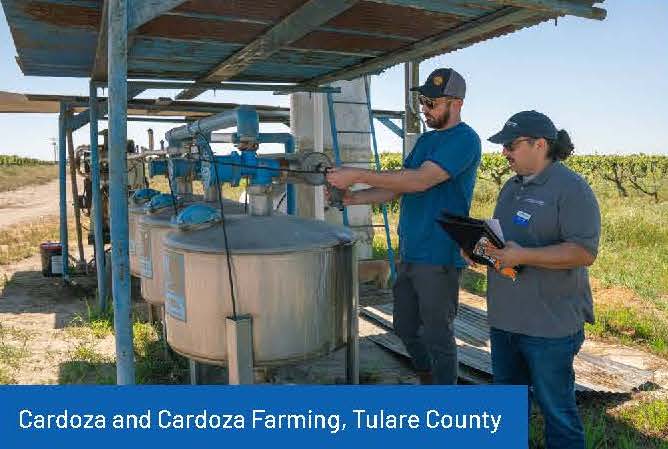
Researchers spent that time learning about the impacts of SGMA on small-scale farming operations by holding on-farm meetings and workshops and through statewide surveys.
“The findings are consistent and concerning,” according to the report’s executive summary. Particularly the prospect of small farms shutting down and reducing available food.
The report also outlines measures that it says are practical steps to avoid that outcome.
One persistent issue, according to researchers, is a lack of communication between GSAs and small farmers.
More than two-thirds of the small-scale farmers surveyed farm fewer than 50 acres and many are also tenants. Yet, GSAs often send ballots, information and fee notices to landowners, overlooking the actual water users. Missed communications can lead to billing surprises devastating small farmers.
The report offers a framework for GSAs to identify small-scale farmers by looking at their groundwater use, community value and financial vulnerability.
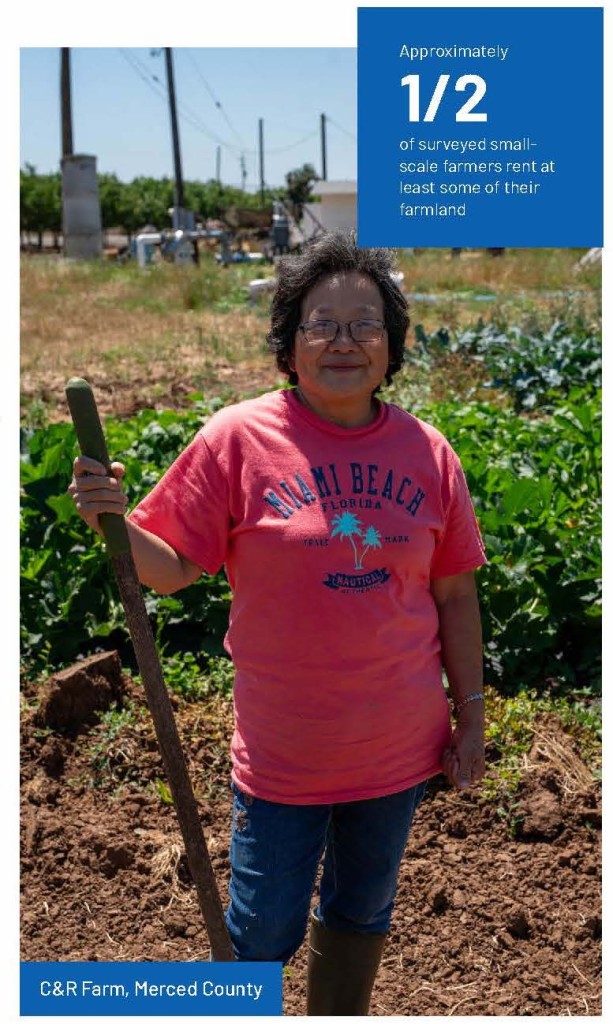
It also suggests the state help GSAs pay for outreach and technical assistance directed at small farmers as well as funding support to help them find less water intensive uses for their land.
Atume said the underlying problem is that pumping allocations don’t distinguish between low-impact and high-impact users.
“I think something at the heart of the concern with allocations is that every agricultural user is being treated the same,” Atume said. “We flagged in the presentation and in the report, small farmers are typically not the ones contributing the most to that overdraft within the subbasin.”
And they don’t have options that larger growers can use to offset new pumping and other SGMA costs.
“We have seen that in (pumping) allocations, often what happens is that large landowners just buy more land,” Catherine Van Dyke, CAFF’s director of water policy, said. “They’re like, ‘OK, well, I’ll leave that portion aside.’ Small farmers just don’t have that capacity.”
The San Joaquin Valley has roughly 34,500 farms. About 77% of those are considered small with fewer than 100 acres of irrigable land, according to the Public Policy Institute of California.