Two San Joaquin Valley water projects snag $34 million in federal funding
Two water storage projects in Kern and Tulare counties received $34 million in federal grants through the Bureau of Reclamation’s Small Storage Grant Program, according to an announcement Thursday.
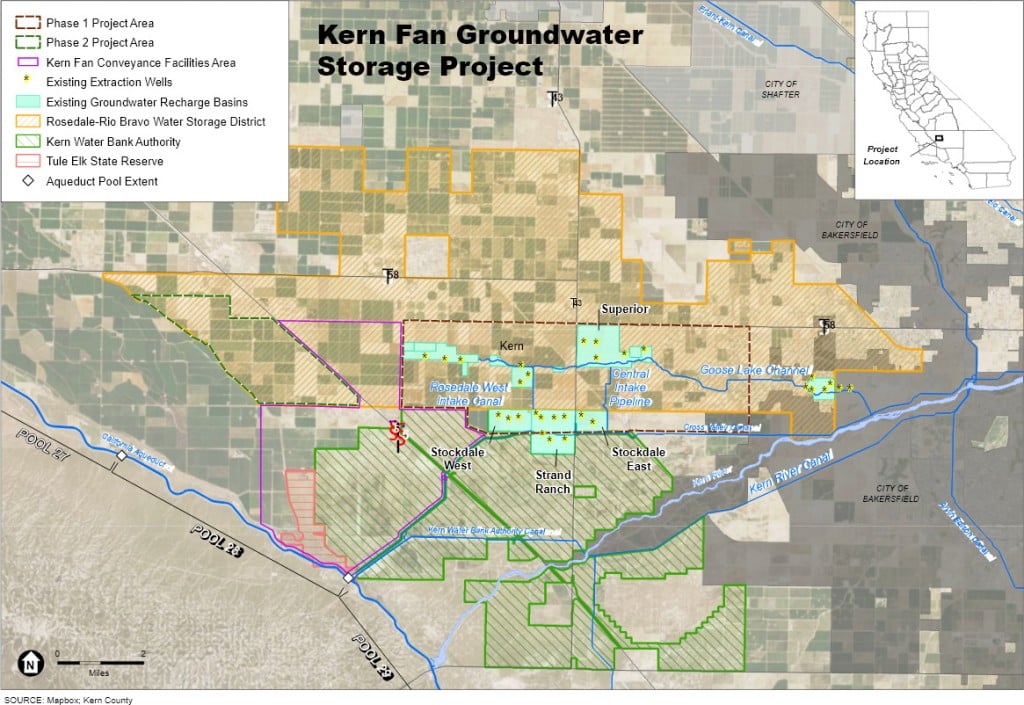
The lion’s share of that funding, about $25 million, will go to the Kern Fan Project, a 1,300-acre groundwater banking project with an environmental “twist” that has been under construction since 2024.
Specifically, this latest federal grant will help pay for a canal within the Kern Fan Project to bring excess water off the California Aqueduct in wet years into the bank. The canal is also expected to help make up for restricted flows caused by subsidence on the aqueduct, according to Dan Bartel, General Manager of the Rosedale-Rio Bravo Water Storage District.
Rosedale-Rio Bravo has partnered with Irvine Ranch Water District on the groundwater banking project, which also received $111 million in California Proposition 1 funding and $8.6 million in federal funding previous to this most recent grant.
“The $25M awarded goes a long way to fund capacity for Rosedale and Irvine Ranch and indirectly helps several other Kern County water agencies capture wet-year water,” Bartell wrote in an email. “This is a Win-Win-Win.”
The environmental “twist” to the Kern Fan Project, and the reason it won Proposition 1 funding, is that 25% of its banked water will be reserved for the California Department of Fish and Wildlife to use, “by exchange,” to benefit fish species during low water years in the Sacramento-San Joaquin Delta.
The water wouldn’t be pumped north. Instead, it would be sent to other users and a like amount would be used, in exchange, for species in the delta.
Rosedale-Rio Bravo and Irvine Ranch broke ground on the first phase in 2024 and expect to complete the project by 2030. At full buildout, the recharge basins are expected to be able to store 100,000 acre feet of water.
Gravel pit to water storage
The remainder of the recent Bureau of Reclamation grant funding, about $9.28 million, will help repurpose an old gravel mine in Tulare County to develop a 235-acre reservoir.
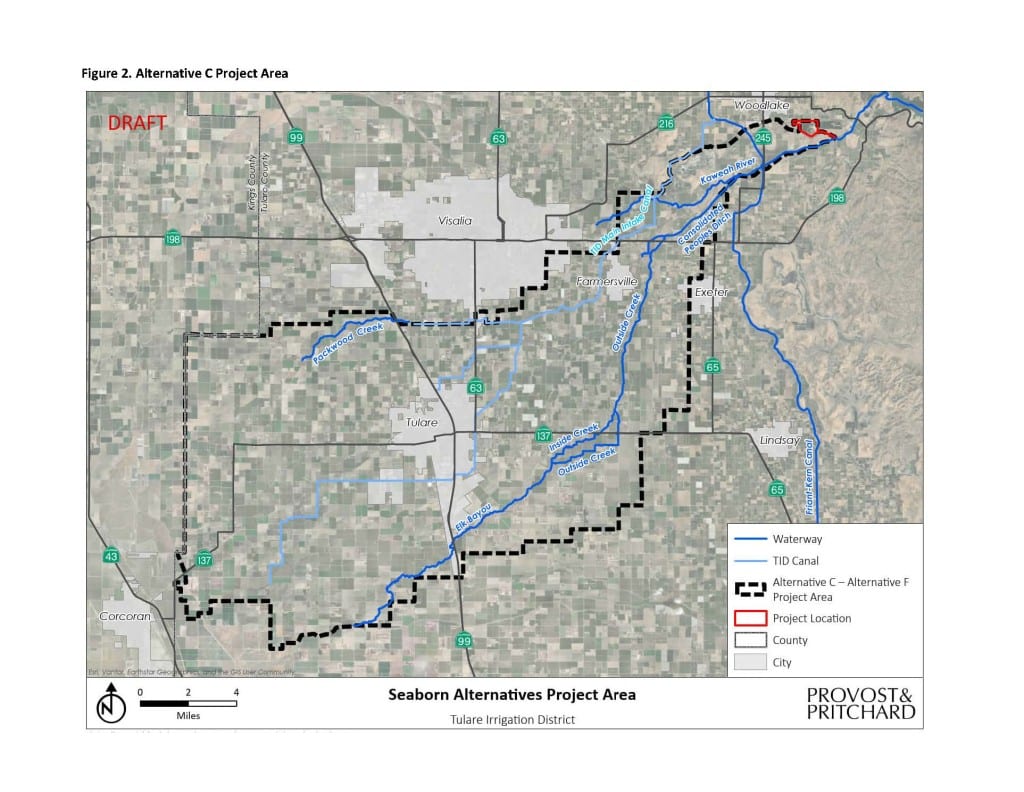
The Seaborn Reservoir is part of a larger project along the Kaweah River watershed proposed by the Tulare Irrigation District which expects to go to bid in 2028, according to General Manager Aaron Fukuda.
“We are excited to get off-stream storage in a timeframe that might be available to help us address our groundwater sustainability by 2040,” he wrote in an email.
When completed, the reservoir would ensure a minimum of 6,500 acre-feet of water storage.
The goal is to improve water supply flexibility during peak irrigation season for Tulare Irrigation District growers and boost groundwater recharge. It would also reduce pumping by Tulare growers.
Fukuda noted a project of this magnitude takes leadership from board members, consultants, and congressional members. According to a press release from Congressman Vince Fong, he and Congressman David Valadao sent repeated letters to the Bureau of Reclamation starting earlier this year urging the agency fund these projects.
“The one trait we all have is tenacity,” he said.
The project already netted a $1 million Natural Resources Conservation Service grant for feasibility and permitting.
Plans also call for the area surrounding the reservoir to be restored as a riparian habitat area. Non-native plants would be removed and replaced with native plant species.
“I think there is a fantastic synergy between the reservoir and the native species,” Fukuda wrote.
Seaborn Reservoir is part of a larger project at the convergence of the Kaweah and St. Johns rivers. A bi-directional, gravity-fed pipeline between Seaborn and the 120-acre McKay’s Point Reservoir would allow for more capture and regulation of flows along both waterways.
McKay’s Point Reservoir will hold 4,500 acre-feet when complete. It is a joint project between Tulare Irrigation District, Consolidated Peoples Ditch Company and the Kaweah and St. Johns Waters Association, which oversees the surface water rights and diversion operations on the Kaweah River.
Authors