Kings County judge considering whether to advance groundwater lawsuit
A Kings County Judge may decide next week whether to allow a lawsuit by the Kings County Farm Bureau to move to the next phase in its quest to prove the state Water Resources Control Board overstepped its authority when it placed the region on probation in 2024 for lacking an adequate groundwater plan.
The Farm Bureau is also disputing what it says was an improper blanket denial by the Water Board of exemptions for some local agencies from those probationary measures, which require farmers to meter and register wells at $300 each, report extractions and pay the state $20 per acre foot pumped.
At a June 3 hearing, Kings County Superior Court Judge Robert Burns said he may rule by June 11 on whether to start the discovery process, where both sides seek documents. If he does not issue a ruling, the parties will meet July 2 to determine next steps.
Judge Burns set a follow up hearing on the merits of the case for Sept. 15 at 1:30 p.m.
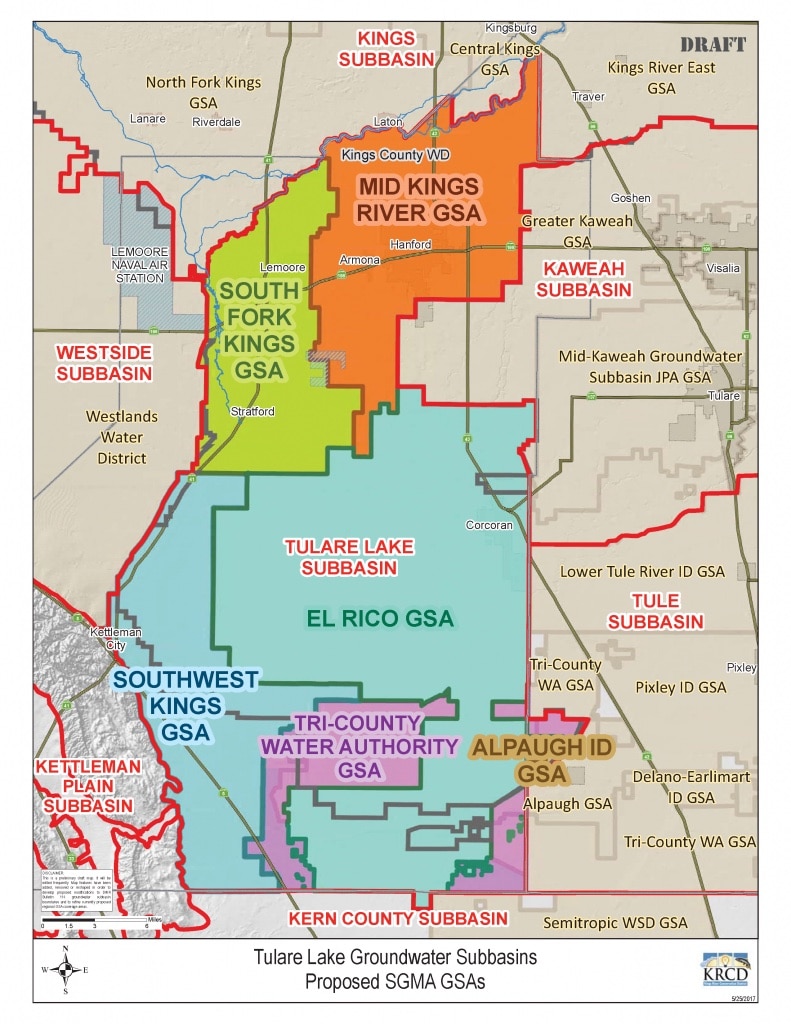
The Farm Bureau sued the Water Board in 2024 after the Tulare Lake subbasin, which covers most of Kings County, was placed on probation.
As that case progressed, the Farm Bureau obtained a preliminary injunction that paused state probationary measures. That injunction was reversed by the Fifth District Court of Appeal in October 2025 and the case was sent back to Kings County.
During the June 3 hearing, both sides argued three main issues: State fees; the balance of harm; and the so-called “good actor” clause, which allows state regulators to exempt groundwater agencies from probationary measures if they are found to be in compliance with the Sustainable Groundwater Management Act (SGMA), even if the rest of the region is out of compliance. SGMA requires local agencies to bring severely overdrafted aquifers into balance by 2040.
Of the five groundwater sustainability agencies (GSAs) in the Tulare Lake subbasin, two sought exemptions: Tri-County Water Authority and Southwest Kings GSA, but were denied.
The state argued that the $20-per-acre-foot amount charged to growers under probation is not a “service fee.” That money is meant to cover administrative costs incurred by having to provide subbasin oversight, according to the state.
Margaret Tides, an attorney for the Water Board, said farmers in regions not complying with SGMA should “bear the costs” of oversight.
Tides said Tulare Lake subbasin farmers would not be alone in paying those costs as farmers in the Tule subbasin, which covers the southern half of Tulare County’s flatlands, are also subject to the fees after that subbasin was placed on probation in September 2024.
The Farm Bureau’s attorney, Valerie Kincaid, argued that the state has applied the fees in an inherently unfair manner.
“(The Department of Water Resources) sent seven subbasins to the Water Board. The Water Board did a vast amount of work. Two were placed on probation. The four that were sent back to DWR got a $0 price tag,” Kincaid told the judge.
The fees have been a bone of contention in the Tule subbasin as well where farmers pushed back against a state proposal in June 2025 to charge smaller pumpers less. At the time, Tulare Lake fees were still on hold and Tule farmers feared they would be on the hook for the entire $6.6 million that the state said it needed to pay for oversight.
That proposal was never enacted.
Kincaid also argued that once the preliminary injunction was reversed in October 2025, the Water Board charged Tulare Lake pumpers fees retroactively to April 2024 even though it had not provided oversight to the region for nearly two years.
“There’s been a large amount of confusion and chaos by the state Water Board’s actions,” Kincaid said, calling the back and forth from the state a “whiplash effect.”
Kings County farmers are estimated to owe $1.7 million in 2024 pumping fees alone and $5.4 million per year for each following year.
While the state said that local communities were harmed, likely by subsidence and domestic well damage from excessive agricultural pumping, Kincaid argued that local groundwater agencies have enacted metering and reporting policies on their own to comply with SGMA.
If so, they should have submitted that information to the state, another attorney said.
“Regulated agencies have had two years to figure it out,” Katie Fritz, the state’s second attorney, told the judge. “Extractors are at liberty to approach the board to submit alternative reporting schemes.”
Water Board staff, though, had declined to speak to, or meet with, water managers in Kings County, from mid-2024 until January of this year citing the pending legal action.
As for the good actor issue, Kincaid referred to the Fifth’s District ruling, which states the Water Board failed to evaluate each GSA individually and instead lumped them into a single probationary pot.
Fritz argued that Tri-County and Southwest Kings GSAs did not provide sufficient monitoring data to be excluded from probation.