Groundwater policies split farmers in small west Fresno County region
Growers in a small western Fresno County region are falling out over groundwater, specifically who should be entitled to how much.
And accusations have started piling up against the Pleasant Valley Groundwater Sustainability Agency (GSA) board president, Jimmy Anderson.
Some farmers say Anderson has manipulated groundwater credits for his own benefit, creating a captive market to sell water and setting up smaller farmers for failure.
The problem, they say, is a groundwater allocation policy that Anderson instituted after he came on the board in January.
That policy gives water credits to land parcels based on historical use versus a per-acre, equal spread as is common in other GSAs. That gave large landowners, like Anderson, more credits regardless of how the land is now being used.
“They’re a bunch of greedy crybabies.”
– Jimmy Anderson, president of the Pleasant Valley Groundwater Sustainability Agency regarding farmers complaining about policies he enacted to increase pumping penalties
Anderson is a cattle rancher with a feedlot that isn’t irrigated. He also has some land planted in pistachios and has grown row crops such as garlic and wheat, which use less water than permanent crops.
The new policy, which he pushed through after getting on the board in January, gave Anderson an abundance of credits that he didn’t have before.
That’s true, he said. And fair.
He calls growers upset with the new allocation “greedy crybabies” who over planted permanent crops and now don’t want to face the consequences.
“The old board told me that a feed yard that’s been there since 1952 wasn’t gonna get any water, and that’s why I got on the board, to be honest with you,” Anderson told SJV Water.
He said he was astounded that the previous board, led by former president Brad Gleason, gave him no credits for his feedlot.
“It blew me away that he said that.”
But Gleason said Anderson’s solution won’t work for the subbasin.
“It boils down to inherent conflict of interest between people making policy decisions and their own individual situation,” he said.
He argues that farmers who invested millions in wells, irrigation systems, trees and cultivation of a crop should get a bigger piece of the groundwater pie than someone with open land “who could walk into a windfall of groundwater credits” that they could sell privately.
Anderson said continuing to allow excessive pumping ignores the reality of the state’s Sustainable Groundwater Management Act (SGMA), which is more than 10 years old now.
“Anyone who says they didn’t know SGMA was coming is either stupid or lying,” he said. “If they decided ‘I’m gonna gamble and plant 100 percent of my acreage,’ well, they are getting what they deserve.”
Instead of pointing fingers, growers upset with the allocation policy should work together to find other sources of water, he said.
“That aquifer has to be protected for many, many, many generations, not these individual landowners who are complaining right now. There are no free rides in Pleasant Valley,” Anderson said.
To resolve the differences fairly, Gleason said he would like to see Pleasant Valley head for an adjudication process. A court decree defines who has rights and how much groundwater they can extract.
That would require a lawsuit, which has not been filed.
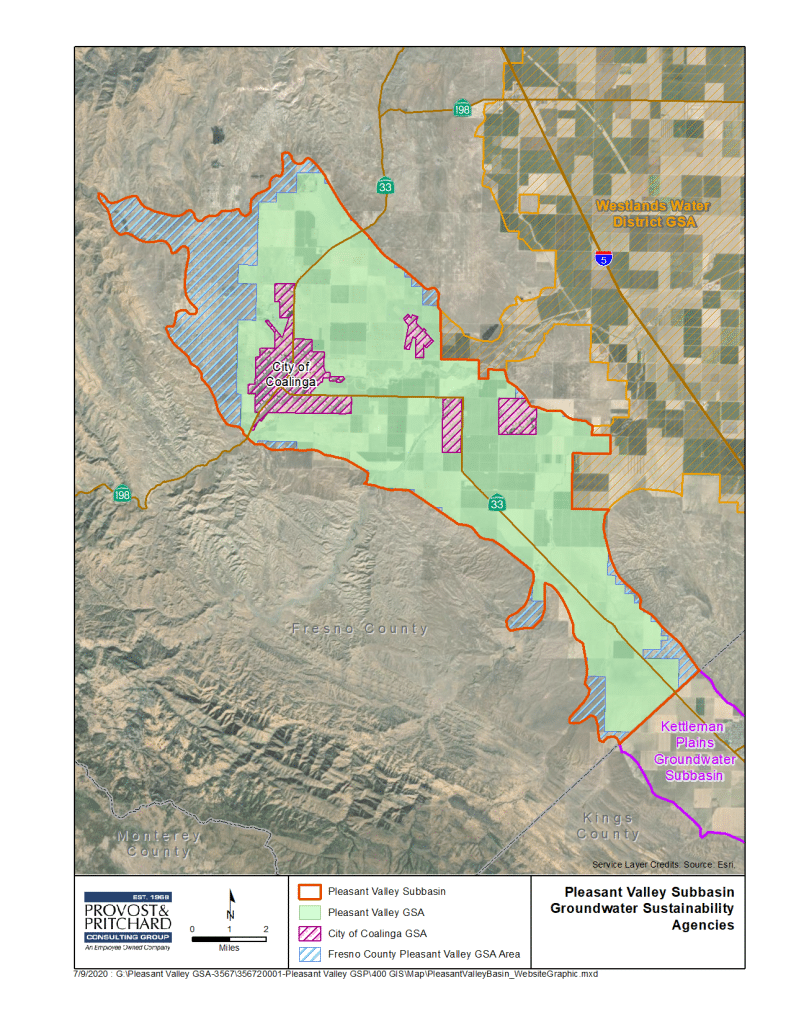
This is all playing out as the state Water Resources Control Board is considering whether to place the 48,000-acre subbasin on probation, which comes with fees and greater scrutiny, for lacking an adequate groundwater plan. A new plan was reworked under Anderson’s board and submitted to the state in April.
But grumbling in the subbasin has grown, including a recent letter sent to all 32 parcel owners in the basin complaining about other recently enacted policies, including a plan to charge growers $750 an acre foot for pumping more than they’re allowed.
Those policies will be discussed at the board’s June 23 meeting at Harris Ranch in Coalinga.
The grower who sent the letter and asked to not to be named for fear of retribution, told SJV Water that Anderson, the largest landowner in the subbasin, is “calling all the shots” on the board.
“Nobody can tell him no. Farmers will tell you, it’s the ‘Jimmy s***t show.’”
Growers are upset about other board actions, including:
- Lack of a basin-wide groundwater accounting platform. Growers say groundwater purchases should be routed through the GSA, with proceeds going toward land repurposing programs that pay growers to retire land, or surface water infrastructure.
- The $750 penalty pumping fee.
- Lack of a transparent budget that shows how penalty fees will be used.
“It’s a hard way of doing business,” said the grower who sent the letters. “Landowners are looking at selling because they can’t afford this.”