Water summit covers gamut of water issues facing Kern County farmers
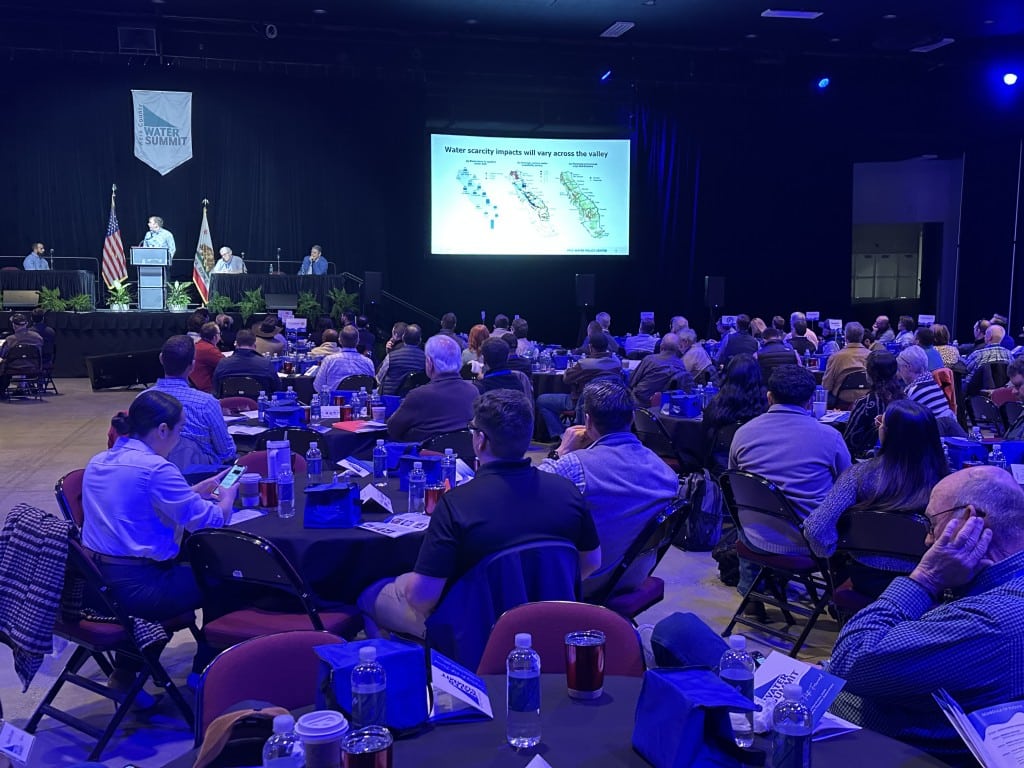
Groundwater regulation and its impacts on farming dominated panel discussions at Thursday’s Water Association of Kern County’s annual Water Summit.
While the picture of how SGMA will likely impact agriculture has become more clear, it hasn’t gotten any prettier over the past 10 years since the Sustainable Groundwater Management Act became law.
The first panel of the day set the tone as farmland appraisers Mike Ming and Allan Barros flipped through slide after slide showing how values have dropped, especially in regions where growers are totally groundwater dependent or even if they have contracts for state water.
The most encouragement Ming could give the crowd was that he sees values “bottoming out” in some Kern County areas, especially those with federal water contracts.
“The market can’t go much lower,” he said. “I know a lot of farmers who are in a tough situation.”
He has said previously that as much as 600,000 acres of currently productive farmland in Kern, Tulare and Kings counties alone will likely have to come out of production because of SGMA regulations.

Barros, who works with growers further north, likewise has seen farmland values stabilizing in some areas. But he could only shake his head at what he’s seeing in other areas, particularly southern Tulare County around Highway 43.
Pistachio groves valued at $20,000 an acre as recently as 2022 are $7,500 an acre now, and they aren’t moving, he said.
Some of that is driven by commodity prices. But both appraisers said the bigger factor is water, particularly for areas without surface supplies.
“Those growers are starting to realize, if they have to pay $300 an acre to build the infrastructure to get water, they might just take that pill,” Barros said.
That panel segued into another about alternate uses for farmland such as solar. But even that has its challenges, as Evan Riley with White Pine Renewables explained. It can take seven to 10 years to get approvals for a utility-scale solar project, he said. Even smaller projects can be moribund by the California Environmental Quality Act (CEQA).
“Every project we complete is a miracle and it shouldn’t be,” Riley said. “What we need is CEQA reform, CEQA reform, CEQA reform.”
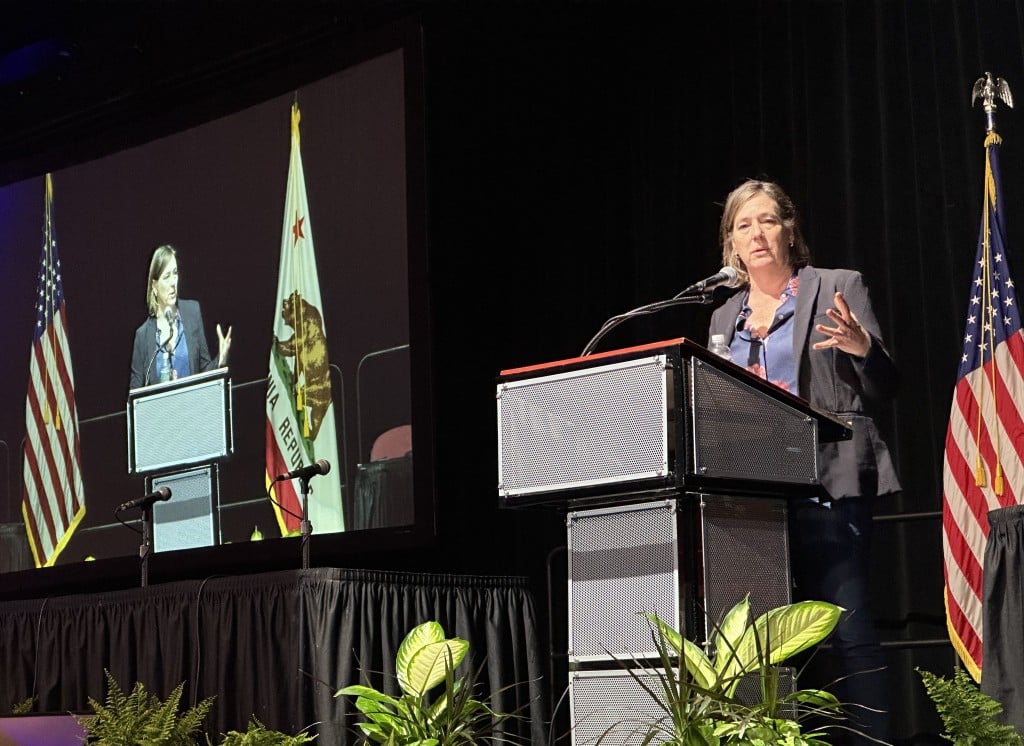
Keynote speaker Karla Nemeth, the director of the Department of Water Resources, said the state recognizes the need to “bust through the red tape” and act with more urgency on infrastructure projects.
“I talk regularly with Governor Newsom about how we can better streamline regulations to get projects built sooner,” she said.
The Delta Conveyance Project, a tunnel to Sacramento river water underneath the ecologically sensitive Sacramento-San Joaquin Delta, was a frequent topic in Nemeth’s speech. DWR is seeking about $300 million from State Water Project contractors to pay for the planning and preconstruction phase right now.
While the Metropolitan Water District of Southern California has committed to $141 million, Kern County agricultural water districts that receive state water have yet to give a thumbs up to paying their $30 million share.
Nemeth said if the tunnel had been in place during the three-day storm that hit California in February, it would have been able to deliver 75,000 acre feet to valley contractors.
“That would have been available for groundwater recharge in the valley,” she said. “That’s huge.”
But a tunnel through the delta is years, perhaps decades, away. Farmers are worried about the bottom line right now as farm values plummet.
Delano pistachio grower Raj Udeshi wanted to know if there is any legal remedy to thwart SGMA, which he felt was a violation of the U.S. Constitution’s prohibition of states passing laws that interfere with contractual obligations, such as those a grower has with their lender.
“Because that’s what we’re all feeling,” he said. “And that isn’t being addressed enough here.”