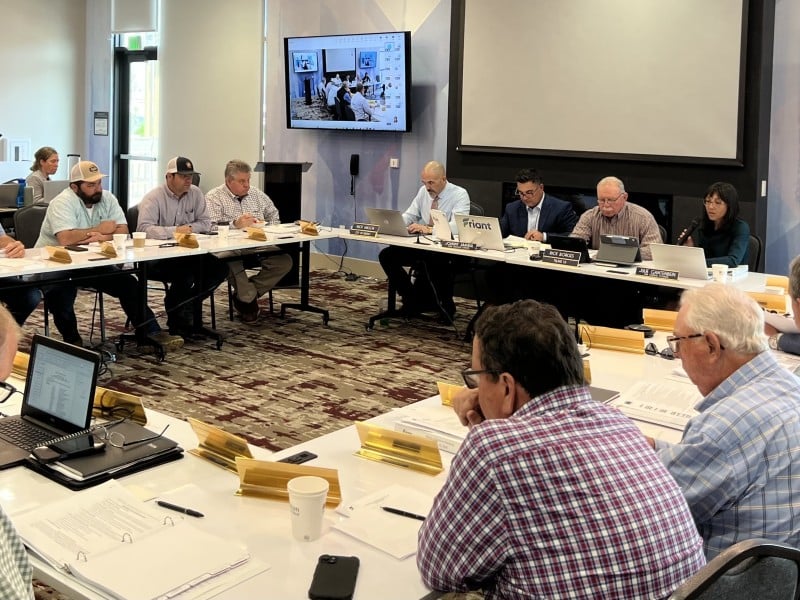
State proposes administrator to take over troubled East Orosi sewer system
A clearer path forward could be emerging in the tiny Tulare County community of East Orosi, which has long struggled with contaminated drinking water, a decrepit sewer system and dysfunction among elected leaders.
The state Water Resources Control Board will be in town Thursday, April 17 to explain why it proposes that the community’s sewer system be run by a new administrator, the Tulare County Resource Management Agency (RMA). The meeting is at 6 p.m. at Iglesia La Paz, 13920 Avenue 418 in East Orosi.
Members of the public may offer comments on the proposal in person, via Zoom, or by email until May 7.

The proposed sewer administration change is a result of Assembly Bill 805, authored by Dr. Joaquin Arambula (D-Fresno) and signed into law by Gov. Gavin Newsom in September in the backyard of an East Orosi resident. The bill authorizes the state Water Board to intervene when a sewer service provider does not meet regulatory standards or fails to maintain the technical, managerial and financial capacity needed to prevent waste, fraud and abuse. The Water Board can then contract with a new administrator.
In the case of East Orosi, Tulare County RMA is already the administrator of its drinking water system, which it took over from the East Orosi Community Services District.
Coordinating water and sewer under one interim administrator is expected to bring much-needed relief to East Orosi residents, who have faced a multi-pronged battle for both clean drinking water and adequate sanitation for decades.
Denise England, grants and resources manager for Tulare County RMA, said she will be at the April 17 meeting.
“We’ve been in conversations with the state, amending our funding agreement to incorporate the sewer system,” she said. “It makes sense for us to do this because we’ve already got a relationship with the community.”
Quarterly meetings, co-hosted with Community Water Center, are held with residents to work through drinking water issues and sewer items will be folded into those, England said.
“We will continue to partner with East Orosi community members to ensure that their voices are heard and to support them in advocating for safe and affordable drinking water and adequate sanitation,” said Erick Orellana, Community Water Center senior policy advocate. “These are basic rights that East Orosi has been without for far too long.”
England said the goal with East Orosi’s sewer system is to first get it back to its original operating capacity and function.
“The solution is straightforward but dealing with the politics on the backside has been challenging,” she said.
England was referring to the East Orosi Community Services District, a three-member board that residents say did not properly manage their drinking water or wastewater systems. The 950-member community relies on two community wells that are contaminated with nitrates.
The state Water Resources Control Board has provided bottled water for about a decade, but did not have authority to intervene in the town’s wastewater issues. That changed with AB 805.
Last spring, sewage backed up into homes when a wastewater pump stopped working, underscoring the need for new management.
Homes are all on septic tanks but pipelines and lift stations move the sewage to a collection system. Residents pay $39 a month to the East Orosi Community Services District to handle that collection, but have long complained of billing discrepancies and even threats to call immigration enforcement on complaining residents.
England said residents will notice immediate changes if RMA is named administrator of the system.
“The first change they’ll notice is they no longer have to work with East Orosi CSD employees to pay their bills, and they will be credited appropriately,” she said. “There will be no more games played.”
Lauren Chew, Community Solutions Manager with Community Water Center, said residents appreciate receiving their water bills in a transparent and timely manner from RMA and the ability to ask questions during the quarterly meetings.
“We support Tulare County RMA being appointed as the wastewater administrator,” Chew said. “We’re hopeful that East Orosi will be provided relief.”
In 2020, the Water Board ordered the larger, nearby city of Orosi to connect homes served by the East Orosi CSD as part of a forced consolidation to bring a permanent solution to the community’s drinking water woes. The state appointed Tulare County to service the domestic wells until the consolidation is complete.
England said that project is on an expedited timeline thanks to a state grant but designing and installing a new sewer system will take longer, she said.
“Sewer money is not as easy to come by,” she said. She is hopeful federal earmarks will speed the project along.
Other Tulare County communities with a drinking water administrator are Teviston and Allensworth, both of which contract with Stantec, a consulting firm.
“(Tulare County) doesn’t have the resources to take on any other small water systems,” England said. “We would like to be successful in East Orosi first.”Eas
At the Tulare County Board of Supervisors meeting March 18, the board approved submitting a financial assistance application to the state water board for wastewater improvement projects for the small communities of Lone Oak and Soults Tract.