State continues to ghost Kings County water managers blaming lawsuit
Even as the state has given Kings County farmers a deadline to begin reporting groundwater extractions, with pumping fees to follow, it refuses to meet with managers who are feeling their way through the silence to rewrite plans that meet state approval.
The state’s lack of communication has created frustration among some.
“It’s kind of astounding to me that this regulatory board in the state of California isn’t talking to Mid-Kings GSA,” said Robert Thayer, a Kings County Supervisor and director of the Mid-Kings River Groundwater Sustainability Agency, during a Dec. 16 special GSA meeting. “This is not our lawsuit.”
Fellow supervisor and Mid-Kings director Doug Verboon shared Thayer’s sentiments.
“I don’t see a win-win here. I know we’re doing all we can to come together with doing what they ask us to do but they won’t even talk to us to tell us if we’re going in the right direction.”
The problem is an ongoing lawsuit filed by the Kings County Farm Bureau against the state Water Resources Control Board for its placement of the region on probation back in 2024. The Water Board found the region did not have an adequate plan to stem damage from over pumping, such as subsidence and drying up domestic wells.
Under the Sustainable Groundwater Management Act, probation comes with requirements for farmers to meter and register their wells at $300 each, report extractions and pay $20-per-acre-foot pumped to the state.
That’s all on top of what farmers already pay their groundwater agencies and water districts.
The Farm Bureau contends the Water Board exceeded its authority and its lawsuit was able to hold those probation sanctions at bay for more than a year after it won a preliminary injunction against the measures. That injunction was overturned in October.
Water Board staff ceased communicating with Kings County groundwater managers at the outset of the lawsuit and has maintained that stance.
“The Farm Bureau’s lawsuit put the Board and local agencies in a difficult position. Despite the disruptive litigation, the Board is doing what it can to support the regulated community,” Water Board Spokesperson Edward Ortiz wrote in an email.
The Farm Bureau has filed a petition with the state Supreme Court over the preliminary injunction issue and is trying to raise up to $2 million for that effort. The main underlying lawsuit is still ongoing in the Kings County Superior Court.
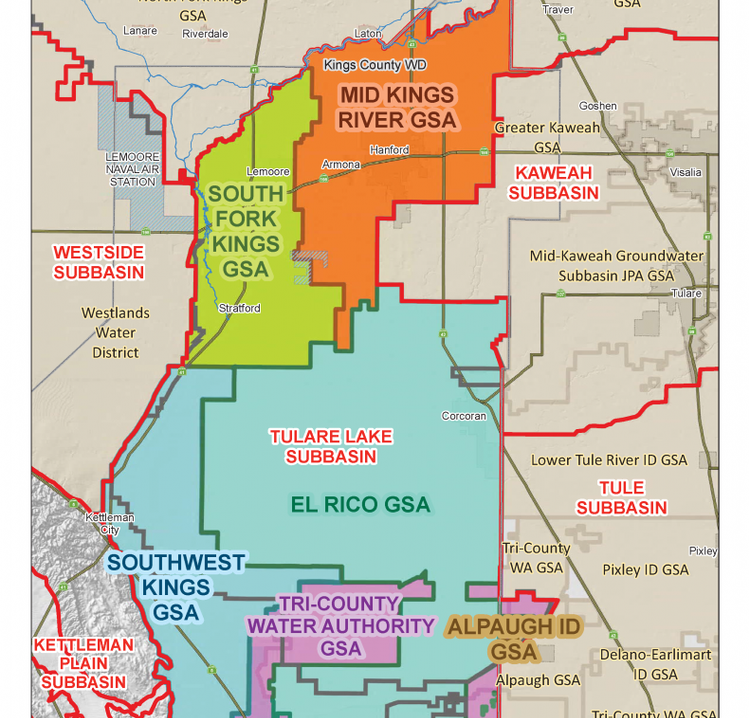
Meanwhile, groundwater agencies are under the gun to come up with a new plan coordinated among the region’s five groundwater sustainability agencies that meets SGMA’s goal bringing aquifers into balance by 2040.
Other regions that have avoided probation have done so with heavy interactions between GSA managers and Water Board staff.
But Amer Hussain, a contract engineer for three Kings County GSAs, told Mid-Kings directors at the Dec. 16 meeting that Water Board staff confirmed to him in a series of emails they would not meet with agencies even after the injunction was overturned.
Natalie Stork, director of the Water Board’s SGMA division, initially said after the injunction was overturned in October that staff would start looking for meeting dates. But she later said there would be no meetings.
“Regrettably, given the highly contentious litigation, the State Water Board will not be meeting with local GSAs at this time. We will let you know when a meeting is feasible,” Stork wrote in an email to Hussain Dec. 10.
Even so, the Water Board announced that farmers would be required to report groundwater extractions starting May 1, 2026 and that fees of $20 per acre foot would follow.
It’s not clear how the Water Board will enforce that mandate without communication or coordination with the five GSAs in the subbasin.
“SGMA’s reporting and fee requirements apply to certain groundwater extractors in the basin, not the local agencies,” Ortiz wrote.