Rural Kings County residents leery of free well testing program that aims to provide clean water
• Editor’s note: Monserrat Solis covers Kings County water issues for SJV Water through the California Local News Fellowship initiative.
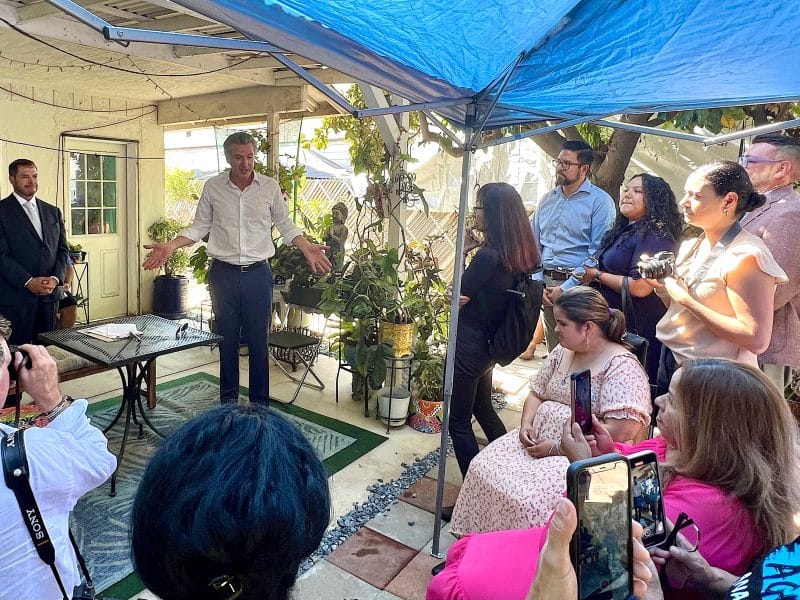
Only about a dozen residents attended a recent event in Hanford to learn about free well testing and organizers learned it’s a trust thing.
“(Rural Kings County residents) don’t want you coming out and checking their water because they’re afraid you’re going to close their well down and tell them they have to dig a new well that they can’t afford,” said attendee Sandra Martin.
“A lot of elderly are afraid.”
Kings Water Alliance Executive Officer Debra Dunn assured attendees the organization has no intent, nor authority, to shut anyone’s well down.
“We do not tell people what to do with their wells,” Dunn said.
The alliance does share its data with the state’s compliance database: GeoTracker, she added.

The alliance’s mandate is to test wells for nitrate and provide free water solutions for families with contaminated water. Dunn asked those at the event to help get the message out.
“We want to make sure that you spread the word about the Kings Water Alliance,” Dunn said. “We are out here just trying to test your wells. That’s all that we’re doing.”
The alliance is an outgrowth of the nitrate control program, adopted by the Central California Regional Water Quality Control board in 2021.
Nitrate is an invisible, odorless and tasteless chemical that is a type of salt. High levels of nitrate can be lethal to newborns, causing a lack of oxygen in the blood, also known as “blue baby syndrome.”
Some studies have also found a link between long-term nitrate exposure and some types of cancer.
A high number of drinking water wells in the San Joaquin Valley are contaminated by excessive levels of nitrate, which is used in fertilizers for farm fields.
The Water Quality Control Board created “management zones” throughout the valley to monitor for nitrate contamination and provide drinking water solutions. Those zones, in turn, started organizations similar to the Kings Water Alliance to reach out to residents directly to provide water tests and clean water, if needed.
Dunn said estimates are that the approximately 10,000 rural Kings County residents on private wells have a 50-50 chance of nitrate contamination.
“The only way to know for sure if your well is impacted by nitrates is to have your well tested,” Dunn said.
She explained at the March 18 meeting that the alliance would send a technician to the resident’s home to get a sample and 48-hours later, they would have the results.
It’s “a painless process,” Dunn said.
Sandra Martin, who attended the event with husband Don, said the couple has lived in Kings County for 50 years and they depend on their domestic well for drinking water. They applied to the alliance’s well testing program in December, but didn’t hear back due to the program’s timing.
“We don’t really know,” Sandra Martin said about whether their well is contaminated. “We’re just interested to find out if we are.”
If a well is contaminated with nitrate, the alliance provides free water bottle deliveries and also maintains three free water fill stations at:
- 504 W. 7th St., Hanford
- 15101 W. Kearney Blvd., Kerman
- 517 W. El Monte Way, Dinuba
Outreach organizations similar to the Kings Water Alliance are located throughout the valley including:
- Chowchilla Management Zone
- Kaweah Water Foundation
- Kern Water Collaborative
- Tule Basin Management Zone
- Valley Water Collaborative, which covers the Merced area.
For more information on management zones or to find your management zone, click here. To apply for well testing, visit the Kings Water Alliance’s website.
Residents interested in attending the alliance’s quarterly meetings may request a virtual link by contacting the alliance. The next meeting will be March 20 at noon.
• Republication or broadcast of SJV Water content is allowed with our reporter’s byline, SJV Water and the following tagline:
SJV Water is an independent, nonprofit news site covering water in the San Joaquin Valley, www.sjvwater.org. Email us at sjvwater@sjvwater.org