Boswell demands correction: Only plans to sink Corcoran six feet, other areas 10 feet
A wide-ranging letter from J.G. Boswell Company Vice President Jeof Wyrick accuses SJV Water of misrepresenting the farming giant’s plan to deal with subsidence, land sinking from excessive groundwater pumping, which has impacted huge swaths of the San Joaquin Valley, including around the small town of Corcoran.
OPINION: Covering Boswell and “how public meetings work”
I received an email Sept. 18 from farming behemoth J.G. Boswell Company’s Vice President Jeof Wyrick asking, among other things, that I “educate” SJV Water’s Kings County reporter on “how public meetings work.”
Reporter Monserrat Solis has been attempting to write about decisions being made by the El Rico Groundwater Sustainability Agency (GSA), which covers about a third of the Tulare Lake subbasin and is controlled by Boswell.
In the email, Wyrick complained that at the GSA’s Sept. 9 meeting, Solis did not immediately leave as the board went into closed session.
“Instead, she walked over to a credenza and started leafing through papers,” Wyrick wrote in his Sept. 18 email. “Please educate her on how public meetings work so they can be done efficiently at (sic) not at her whim.”
Solis said she was not “leafing through” random papers. She was looking at the agenda and agenda packet.
Neither of those documents is posted on El Rico’s website, nor are meeting minutes. The website has an email address to request being put on an “interested parties” list to receive agendas and meeting notices.
Solis requested to be put on that list, through the website. But her email address was, apparently, input incorrectly. It was not corrected for months even after she gave Wyrick and El Rico’s general manager J.J. Westra her business card, as she had not been receiving any notices from the agency.
At one point Solis was told by an El Rico employee that the GSA has “no legal requirement to maintain an interested parties list,” though that is an express requirement under the Sustainable Groundwater Management Act (SGMA).
Until she began receiving emails from El Rico starting Sept. 8, she occasionally needed to look at the agenda in the El Rico meeting room. In this instance, she asked the board for permission to take the agenda outside the room, in order to leave during closed session, and promised to leave it with the receptionist.
El Rico has been inhospitable, some might say downright intimidating, in other ways.
Solis is required to wait in the hallway outside the boardroom, even though other members of the public are allowed in, until she’s “escorted” inside.
She’s then instructed where she’s allowed to sit.
“For the record, the Brown Act guarantees public access to meetings of governing boards of local agencies,” wrote First Amendment Coalition’s Legal Director, David Loy, in an email seeking clarity on this issue.
“An agency may not discriminate against a member of the public, and certainly not against a member of the press, in the terms and conditions of attending a meeting.”
That means Solis has every right to go into the meeting room when it’s open and choose whichever chair in the public seating area she wants, just like other members of the public are allowed to do.
Boswell is a private company that may conduct its affairs how it wishes.
The El Rico GSA is not. It is a public agency.
As such, it must abide by public access and transparency laws. Creating arbitrary hurdles to basic information on the workings of the agency may not break the word of those laws, but certainly tramples on their spirit.
In any event, I don’t think it’s Solis who needs to be educated on “how public meetings work.”
– Lois Henry, Editor/CEO, SJV Water
Wyrick is also the chair of the El Rico Groundwater Sustainability Agency (GSA), which is controlled by Boswell and covers mostly Boswell land.
El Rico doesn’t plan to sink Corcoran by another 10 feet, according to Wyrick’s Aug. 12 letter.
Just six feet.
It may be relevant to note that El Rico’s plan would possibly lower the Corcoran levee, which protects the town and two state prisons, to a height of 186 feet. During the 2023 floods, the state had to do an emergency rebuild of the Corcoran levee after it had sunk to 188 feet.
SJV Water sent Wyrick emails seeking comment about the levee elevation in its subsidence plan but did not receive a response.
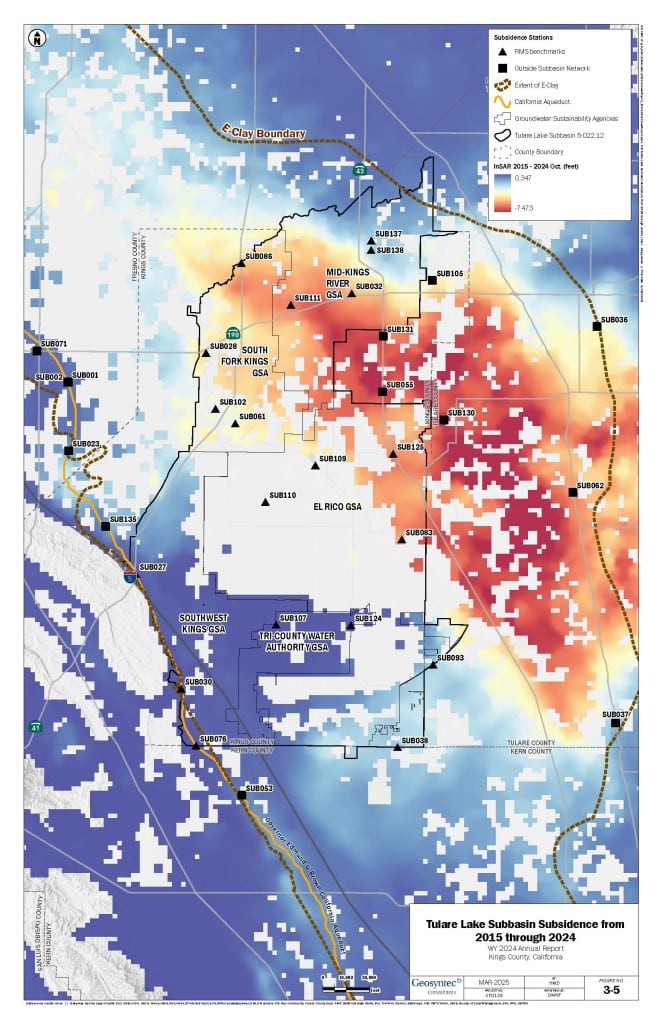
Beyond Corcoran, El Rico does plan to continue allowing enough pumping in a section of the old Tulare Lake bed that it could sink up to 10 feet. But that area is four miles from Corcoran, Wyrick states in the letter.
“El Rico expresses its disappointment with your misrepresentations and lazy reporting,” Wyrick’s letter states.
The letter was approved by El Rico’s seven-member board, which is made up of four current Boswell employees and one retired Boswell employee.
Wyrick was responding to an SJV Water article published in July about other Kings County GSA managers who are trying to hold subsidence in the region to less than six feet. The article was re-published by several other news organizations.
Amer Hussain, a consulting engineer who represents three of the Tulare Lake subbasin’s five GSAs and is also listed as its groundwater sustainability plan manager, stated in several public meetings that the 6-foot subsidence goal would be more difficult if El Rico insisted on up to 10 feet of subsidence.
Prior to publishing that article, SJV Water reached out to El Rico General Manager J.J. Westra by phone for a comment, but did not receive a response.
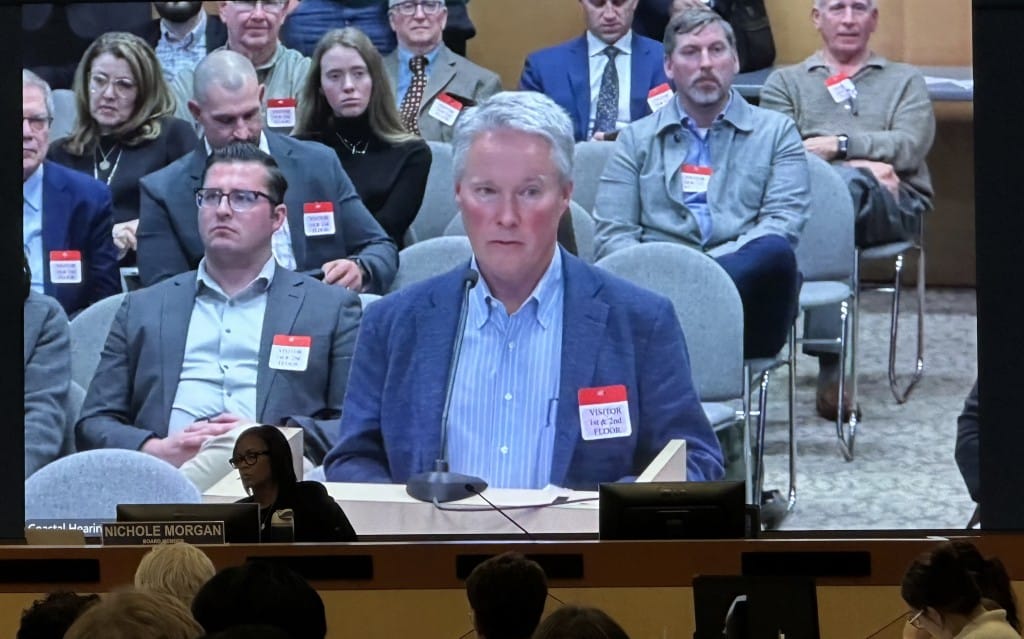
“Should any of you read the subsidence plan, these facts would be evident,” Wyrick’s letter states about the locations of the anticipated 10 feet versus six feet of subsidence.
Wyrick also took issue with satellite maps presented in various GSA and technical meetings by Hussain that show land elevations throughout the region, but that are largely blank over land within El Rico’s boundaries. In some presentations, those maps contained question marks over El Rico’s land.
El Rico, Wyrick’s letter states, has a number of subsidence benchmark monitoring sites that are surveyed annually by the Kings River Conservation District. The satellite imagery likely doesn’t show land elevations on much of El Rico’s territory because there isn’t infrastructure out there, he writes.
“It is evident, yet again, that the reporter and commenters have not read El Rico GSA’s plan,” the letter states.
The letter goes on to criticize both Kings County Supervisor Doug Verboon and Mid-Kings River GSA for a variety of issues.
Wyrick is correct on two issues with regard to SJV Water’s article.
El Rico’s subsidence plan allows for up to six feet of sinking beneath Corcoran and up to 10 feet in the lake bed. And the plan shows several existing and proposed on-the-ground subsidence monitoring sites.
SJV Water regrets any shortcomings in its previous reporting.
Information from El Rico’s subsidence plan certainly would have been included in the July article had it been provided, or even readily findable.
The plan Wyrick references is part of an April 2024 rewrite of the Tulare Lake subbasin’s overall groundwater sustainability plan.
That 2024 plan, however, was not approved by all five of the subbasin’s GSAs and so was never reviewed by the Water Resources Control Board before the board placed the region on probation in April 2024.
Probation comes with strict state oversight and extra fees. Those sanctions have been held at bay pending the outcome of a lawsuit filed against the Water Board by the Kings County Farm Bureau.
The plan Wyrick references is not on El Rico’s website.
It is not on the Department of Water Resources’ Sustainable Groundwater Management Act (SGMA) portal, where GSA plans, annual updates and public comments are collected and made publicly available.
And the plan is not on the “state intervention” tab on the SGMA portal.
Upon receipt of Wyrick’s letter, SJV Water immediately sought a copy of El Rico’s subsidence plan from Wyrick, which he eventually sent through “snail mail,” though it was requested in electronic format.
Wyrick said the plan was sent to the state at some point in the past but it is not posted on any publicly facing websites that SJV Water could find.
That is likely because of the pending lawsuit and the fact that nearly all communication between GSAs in the Tulare Lake subbasin and the Water Board has ceased.
Wyrick also notes in his letter that, regardless of having a plan accepted by the state, El Rico has already instituted pumping reporting requirements, limits and extraction charges for its farmers.
Subsidence is one of the main targets of SGMA, which aims to have local agencies bring over drafted aquifers into balance by 2040. It is also one of the most difficult issues for water managers and farmers to get a handle on without the addition of more surface water as the only remedy is curb pumping, which means less farming.