Bakersfield’s hodgepodge of water systems ready as they can be for major fire
Email: lois.henry@sjvwater.org
After the shock of learning that some fire hydrants went dry at the height of the battle in the Los Angeles fires, readers began asking if it could happen elsewhere. Even Bakersfield?
The unsettling answer is yes.
It’s not an idle consideration. In fact, the Forest Service’s wildfire risk assessment states homes in Bakersfield are at greater risk of fire than 84% of communities in the United States.
The often bone-dry climate combined with occasional high winds could put the community just one well-timed spark away from disaster.
How ready are Bakersfield’s patchwork of water systems? That depends.
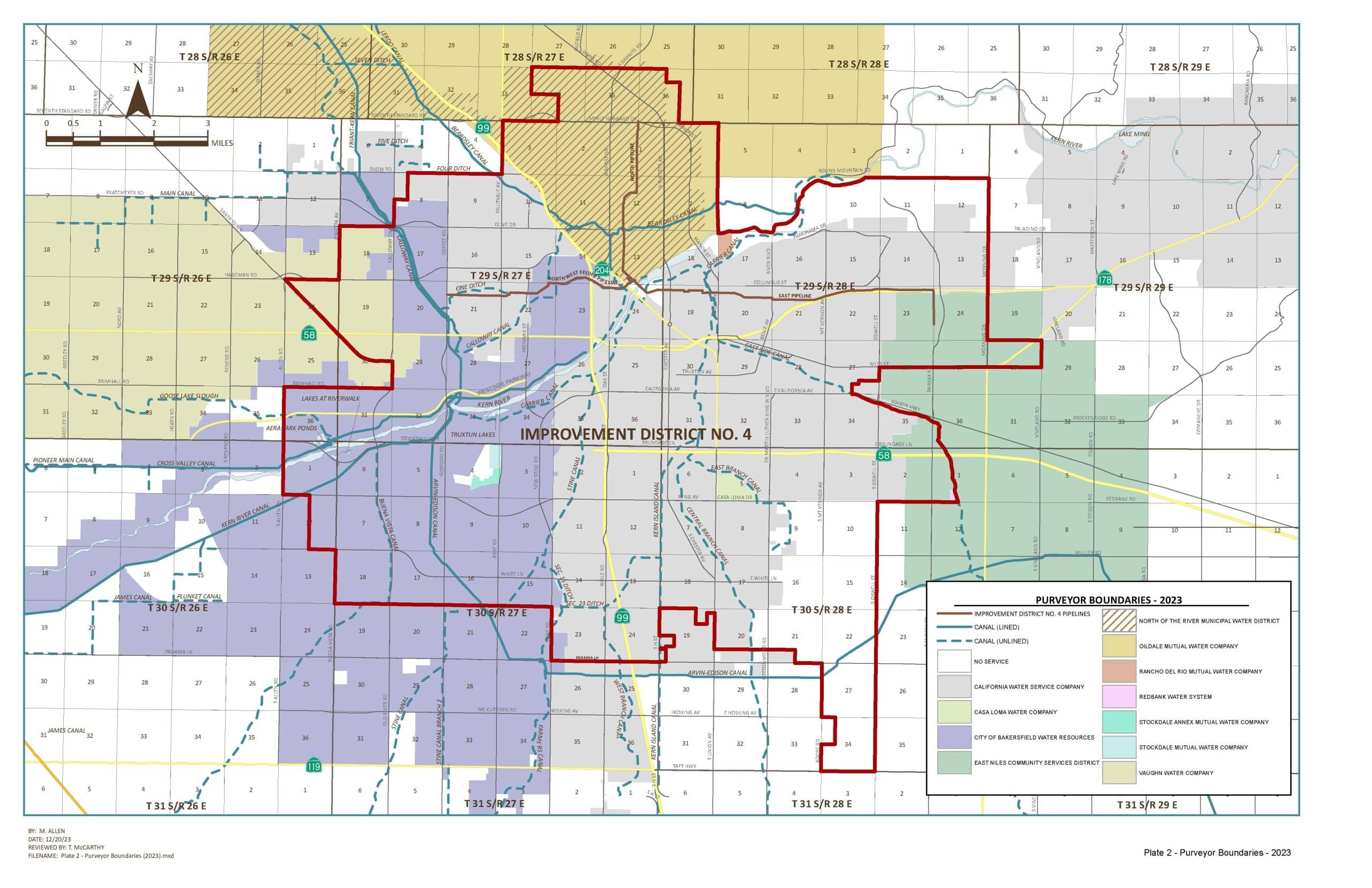
No urban water system is designed for the sort of LA-level conflagration the world just witnessed, managers of four of Bakersfield’s five main systems agreed.
That doesn’t mean they’re unprepared, they are – up to a point.
Tipping point
But that tipping point can be reached quickly under the right circumstances no matter how many redundancies are built into a system.
“We have enough water to fight a big fire,” said Tim Ruiz, General Manager of East Niles Community Services District. “But let’s say you had 20 fire engines tapping the system at once, no one could withstand that.”
Likewise, Van Grayer, general manager of Vaughn Mutual Water Company in northwest Bakersfield, estimated its system could maintain full pressure for about a half hour with a dozen fire engines pulling on hydrants at full capacity.
““That’s not a lot of time, it would go fast with that many engines,” Grayer said.
Even on non-LA sized fires, water managers routinely work with first responders to rejigger their systems to keep pressure up, said Tammy Johnson, Director of Field Operations for CalWater’s Southern Region.
“It happens all the time,” she said. “They (firefighters) might be hooked up to two or three sites and pressure goes down, we work to increase pressure as they need it.”
Those larger water systems serving Bakersfield all have a number of failsafes, including storage tanks, generators, 24/7 monitoring, pressure alarms and tie-ins to each others’ systems to keep from running out of water or power.
Oildale Mutual Water Company has more than 17 million gallons in storage tanks along with “five backup wells that can pump groundwater in an emergency if there is power,” wrote General Manager Ryan Nunnley in an email.
The City of Bakersfield, through a spokesperson, deferred questions about its system to CalWater, which maintains and operates the city system. Though the city does maintain its own fire hydrants.
No overall training
But regular emergency training and communication protocols among all the systems and first responders appears lacking.
Cal Water does hold an annual emergency training program, Johnson said.
The utility runs various scenarios with the fire departments, Sheriff’s office, hospitals, schools and even the FBI.
But the other water purveyors typically aren’t involved, she said.
Ruiz and Grayer confirmed that, while they do a lot of testing and analysis of their own systems, they haven’t been involved in any larger, community-wide training operations.
“I think it was eight or 10 years ago, the city fire department wanted to meet with all the water systems to check our hydrants and know more about our storage,” Ruiz recalled.
“Yeah, there’s really been nothing since then,” Grayer said.
The large purveyors, including Cal Water, Vaughn, East Niles, Bakersfield and Oildale Mutual do meet monthly at the Urban Bakersfield Advisory Committee under the Kern County Water Agency to discuss water issues in general. But the focus isn’t emergency response and preparedness.
Scattered, small systems
There may be a larger issue in and around Bakersfield – small water companies.
A search of the Division of Drinking Water’s water watch website shows about 40 small mutual and community water systems from Choctaw Valley east of Bakersfield to the Gooselake slough west of town.
Collectively, those systems serve about 8,000 people.
These smaller systems are often operated by neighborhood volunteers, not water companies with professional engineers and service divisions. They typically have one or two wells usually without any power back ups, such as generators.
“We’ve looked at small systems in the area that don’t even have fire hydrants,” Johnson said.
If there are hydrants, crews from Kern County Fire Department stations that cover the area do inspect and test them, said public information officer Capt. Andrew Freeborn.
“It’s on each of the companies – and there are a lot out there – to maintain and fix the hydrants to keep them in good working order,” Freeborn said. “But we do make sure they’re working, flowing correctly and not leaking.”
He added that Kern fire crews regularly train on how to fight fires in low water, or even no water conditions and how to find alternate sources of water, including canals.
“We consistently train on what to do in those situations so if there’s a drop in pressure from a hydrant, or there is no hydrant, it’s not the end of the world for us, we’ll find a solution.”