MEETING NOTES: Kern water districts pledge millions toward fight against invasive mussels
Meetings:
Feb. 10 – Arvin-Edison Water Storage District , AGENDA
Feb. 11 – Wheeler Ridge-Maricopa Water Storage District, AGENDA
Feb. 11 – Indian Wells Valley Groundwater Authority, AGENDA
Feb. 12 – Cawelo Water District, AGENDA
Mussel fight gets pricey
The Arvin-Edison Water Storage District and Wheeler Ridge-Maricopa Water Storage District boards both agreed recently to spend $2.5 million and $2 million, respectively, on efforts to rid their systems of invasive golden mussels.
At its Feb. 10 meeting, Arvin-Edison’s Resource Manager Samuel Blue laid out a two-phase attack against the mussels.
First, Blue plans to start with a chemical treatment called Natrix CA in March, when there is less water demand by district farmers and the temperatures are cooler. The mussels are more active in warmer water, Blue explained.
He hoped the treatment would kill off 90%, or more, of the adult golden mussels.
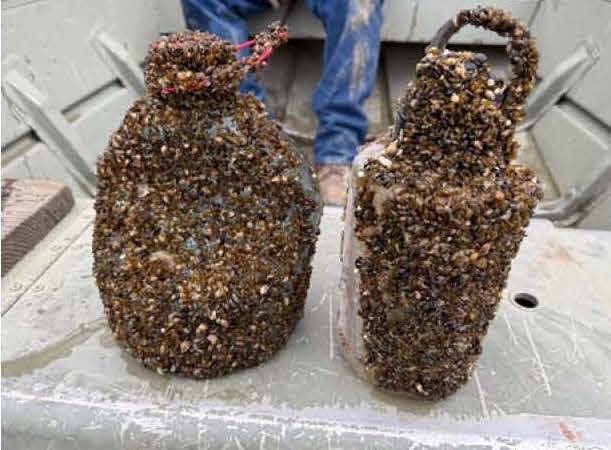
Phase two will target the mussel veligers, larvae that float in the water for two to three weeks before attaching to weirs, pipes and equipment. Blue plans to target chemical treatment at the times of year when Arvin-Edison receives water from its two major sources to keep the veligers from infiltrating the local system.
The board agreed to hire SePro Corporation for treatment and Dudek for environmental consulting.
The next day, at its Feb. 11 meeting, the Wheeler-Ridge board approved spending $2 million on mussel treatments in 2026 with the expectation that costs will drop to $1.5 million and then $1 million in following years.
Wheeler-Ridge Water Resource Manager Eric McDaris said he intends to use a product called Earth Tec QZ for Wheeler Ridge’s treatment protocol. David Hammond, a senior scientist at Earth Science Labs, who helped develop Earth Tec QZ recently spoke at the Tulare World Ag Expo.
This new cost could affect how much the district charges landowners for district operations and maintenance, increasing the rate by $27.75 per acre.
One board member asked if the district could wait to see which eradication method works best.
Wheeler-Ridge Engineer Manager Sheridan Nicholas said the problem with that approach is that golden mussel populations grow so rapidly, waiting could lead to significant infrastructure issues such as pipes filling with mussels.
Dennis Atkinson, president of the board, asked if the Department of Water Resources would be paying for treatment and whether it was looking at which shipping company brought the mussels into California’s water system.
“There is a breakdown in the inspection and safety issues in the state of California, and the state has failed to protect us,” Atkinson said. “Those ships that are coming in from the Orient are not following the rules. Now we have a contaminated system that is going to cost us millions of dollars.”
Steve Torigiani, legal counsel for the district, said he would reach out to DWR to see what he could learn.
Poso water right generates decades of paperwork
The Cawelo Water District board got what has become a long running, recurring update on its quest for the final approval of its diversion point for Poso Creek water.
The district obtained rights to extract water from Poso back in 1985 from a series of sand dams in the creek channel. In 2003, it sought approval from the state Water Resources Control Board Water Rights Division for a permit to change the location of those extractions – not the amount of water it would extract – to a weir it planned to build.
The district was allowed to extract its water from the weir, built in 2007, but the official permit has remained in governmental limbo for all this time.
About two years ago, the district put out a public notice that it was going to petition the Water Board for a permit.
“There’s no physical work being done,” Cawelo General Manager Dave Ansolabehere explained. “This is just getting the paperwork to follow what we’ve already been doing for 20 years.”
But now, he told the board at its Feb. 12 meeting, the Water Rights Division may require a full impact report under the California Environmental Quality Act for possible future impacts as the requested permit would extend to 2040.
“I’m hoping for an exemption by looking back at what the actual impacts have been since 2003,” Ansolabehere said.
The district’s attorney suggested it may be simpler to do an initial study that would likely find the permit would not result in any to existing operations.
“I would like to get this done before I retire,” Ansolabhere later told SJV Water.
The board took no action on this matter, it was only informational.
Desert groundwater agency working on coordination
Indian Wells Valley Groundwater Authority water resources manager Jeff Helsely, with Stetson Engineering, reported that the authority is working with the Bureau of Land Management, Southern California Edison and Blue Mountain Development group on a variety of tasks connected to its water import project.
The authority plans to build a 50-mile long pipeline to bring water to the overdrafted region from the California Aqueduct branch that runs through the Antelope Valley.
Helsely reported at the authority’s Feb. 11 meeting that the authority is working with BLM on environmental documents, Edison on designing power facilities for pump stations along the pipeline and Blue Mountain to identify any issues that would need to be streamlined in the plan.
The board also appointed April Keigwin as the authority’s new general manager. Keigwin previously served as the clerk of the board. She replaces Carol Thomas-Keefer, whom the board reported will still be staying on the authority staff working on other projects.