Speaker series asks audiences to consider Tulare Lake’s past, present and future
Speakers are lined up to offer five free public talks about Tulare Lake, a body of water that many didn’t know existed until massive flooding in the spring of 2023 prompted its rebirth and generated national headlines.
“Most people in California and our area still don’t know about Tulare Lake, because this is not part of our taught history,” said organizer Barbara Brydolf. “Awareness of the lake has really only been since the recent floods and even then considered an anomaly. I want people to know and understand what the Tulare basin was like before Europeans came, what happened to ‘disappear’ the lake, and as Vivan Underhill so eloquently states, the ‘Colonial Unknowing’ that took away our responsibility for what happened.”
The series, “Pa’ashi (Tulare Lake) Past, Present and Future” kicks off on Thursday, Jan. 16 with retired College of Sequoias professor Rob Hansen. “Pa’ashi” is the lake’s name in the Tachi Yokut language.
“I will do my best as an ecologist and a naturalist to help the audience develop an appreciation for Tulare Lake’s past, its natural history and human history,” Hansen said, noting that the unique landscape and wide array of wildlife was often referred to as the ‘Serengeti of California.’
All speakers will discuss how the lake played, and continues to play, a role in the lives of Tachi Yokuts Tribe members.
The series is organized by Brydolf, president of the Alta Peak Chapter of the California Native Plant Society, as part of the Power in Nature coalition, whose purpose is to promote Gov. Gavin Newsom’s goal of protecting 30 percent of the state’s lands and waters by 2030.
Speakers include:
- Jan. 16: Robert Hansen, retired biologist and professor
- Feb. 13: Robert Jeff, vice-chairman Tachi Yokuts Tribe
- Feb. 27: Mark Arax, author of “The King of California” and “The Dreamt Land”
- March 20: Vivian Underhill, assistant professor of anthropology, UC Santa Cruz
- April 10: Julie Rentner, president of River Partners
Each talk will begin at 5:30 p.m. in the Ponderosa Lecture Hall at College of the Sequoias, 915 S. Mooney Blvd, Visalia. Admission is free. The college will post recordings of the talks on its YouTube channel. Attendees are welcome to record the talks on their own as well.

“We have known for quite some time that the way we farm in the Tulare basin is not sustainable but we haven’t changed our approach,” she said. “Now farmers will have to retire farmland and land prices are falling.”
Brydolf said the Sustainable Groundwater Management Act, passed in 2014, has had the opposite effect, with more groundwater pumping than ever before, causing poor water quality and subsidence, irreversible land sinking.
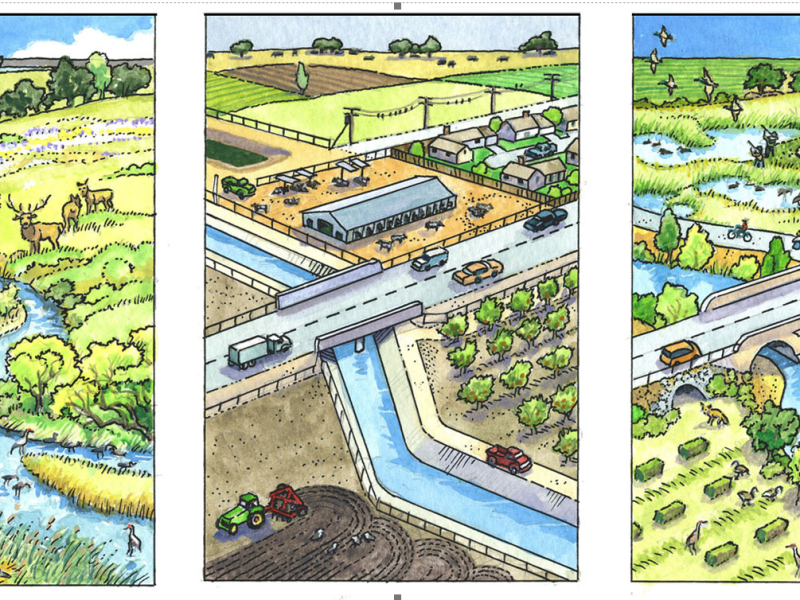
She points to the state’s Multibenefit Land Repurposing Program (MLRP) as a good model for alternative ways of managing land in the Tulare Lake basin.
“I’d like to explore other ways that we can strike a balance between nature, people and farming.”
She said Rentner will speak to the benefits of river restoration, and the importance of connecting rivers to their floodplains. Tulare Lake was originally fed by four major rivers — the Kern, Tule, Kaweah and Kings.
Hansen calls the entire series a “can’t miss” event and offers this takeaway to those who attend his lecture.
“If anyone in the audience feels embarrassed about where they live, like the Valley is just a big, flat, ugly, boring place, I plan to share my own ‘sense of place’ that celebrates what I call the ‘Tulare Valley,’ a distinct place with unique geology, soils, climate, hydrology, habitats, wildlife, ecology, human history, economy, and culture.”
The speaker series is co-sponsored by the Cultural and Historical Awareness Program at COS. Each lecture will begin with a blessing performed by members of Tule Valley Allies, the campus Native American club.